

 +1.844.3539.746
 info@flexsin.com
The Real Reasons AI In Logistics Scaling Efforts Break Down Often
 Munesh Singh
Let's talk
Table of Contents:
- What This Comes Down To
- The Strategy Gap in AI in Logistics Programs
- Where Enterprise AI in Logistics Programs Break Down
- Flexsin’s Supply Chain AI Maturity Model
- Flexsin’s Position on AI in Logistics
- What Good Logistics AI Looks Like:
- The Benefits and Limitations of AI in Logistics
- People Also Ask:
- What Leaders Ask Us
The tools aren’t the problem – most logistics organizations already have them, along with the Cloud Engineering Services and the vendor pitches. What they lack is a clear answer to one deceptively simple question: what, exactly, are we trying to make smarter, and in what order? That gap is where most AI programs quietly run out of budget and credibility.
Recent Gartner research on logistics AI strategy makes the situation concrete. Just 23% of supply chain leaders report having a formal supply chain AI strategy in place – even among those who have already deployed AI tools. Most current implementations are disconnected projects, optimizing a route here, forecasting a SKU there, without the architecture to connect those wins into compounding advantage.
The companies that get it right share one counterintuitive trait: they spend more time on data governance and use-case sequencing before writing a single line of model code. That discipline – boring to sell, hard to rush – is what separates the 307% ROI outliers from the majority who report no measurable returns within 18 months.
- Most logistics AI investments stall not because of technology, but because of unresolved data and strategy gaps that precede model deployment.
- McKinsey research shows AI-driven supply chains can cut logistics costs by up to 15% and reduce demand forecasting errors by 20 to 50% – but only with the right sequencing.
- The dominant failure mode is the ‘franken-system’: layered AI projects that create integration debt faster than they create operational value.
- A maturity-model approach – moving from reactive analytics to autonomous optimization in deliberate phases – improves adoption rates and ROI timelines.
- Predictive maintenance, route optimization, and demand sensing are the highest-value entry points for logistics AI because their data inputs are already structured and their outcomes are measurable within quarters, not years.
The Strategy Gap in AI in Logistics Programs
Here is the uncomfortable truth about AI in logistics: the industry has no shortage of successful pilots. Almost every major 3PL and enterprise shipper can point to a proof of concept that worked. A pilot, by design, lives in a controlled environment – curated data, a patient team, a forgiving timeline. Scale it, and the cracks appear fast.
However, jump from pilot to enterprise deployment exposes every data quality debt the organization has been carrying for years. Demand forecasting models trained on clean historical CSVs start producing garbage the moment they hit the messy, multi-source, inconsistently labelled reality of live operations. The data infrastructure – and the strategy that was supposed to address it – never existed.
This is precisely why Gartner flags what it calls ‘franken-systems’ – complex, layered AI architectures built project by project without a unifying strategy. They create integration debt faster than operational value, and they consume the credibility of the AI program in the process. The project-by-project approach, which most CSCOs default to, is the single biggest threat to long-term AI ROI in logistics.
Where Enterprise AI in Logistics Programs Break Down
Execution failure in logistics AI tends to cluster around three predictable pressure points.
The Data Readiness Trap
AI-based inventory management can reduce holding costs by 20 to 30%, according to Gartner research. That figure is real. What the headline omits is the prerequisite: structured, clean, consistently labelled inventory data across every node in the network. Most logistics operations have none of that at the start. Generative AI consulting that budget for AI but not for the data engineering that precedes it are building a program that will underperform on its own terms.
The Workforce Alignment Gap
A recent Deloitte survey found that 72% of logistics AI implementations that failed cited workforce resistance – not technical failure – as the primary cause. That statistic deserves more attention than it typically gets. The best demand forecasting model in the world produces zero value if the planning team doesn’t trust it enough to act on its outputs. Adoption is an organizational design problem, not a change management checklist item.
The Integration Debt Spiral
Enterprise logistics environments are rarely greenfield. The average supply chain operation runs on a mix of ERP systems, warehouse management platforms, TMS tools, and carrier APIs – often layered over decades, often incompatible at the data level. Deploying AI on top of that stack without first resolving integration architecture is, to put it plainly, expensive guesswork. The AI will produce an answer; what’s uncertain is whether the data feeding it reflects operational reality.
Flexsin’s Supply Chain AI Maturity Model
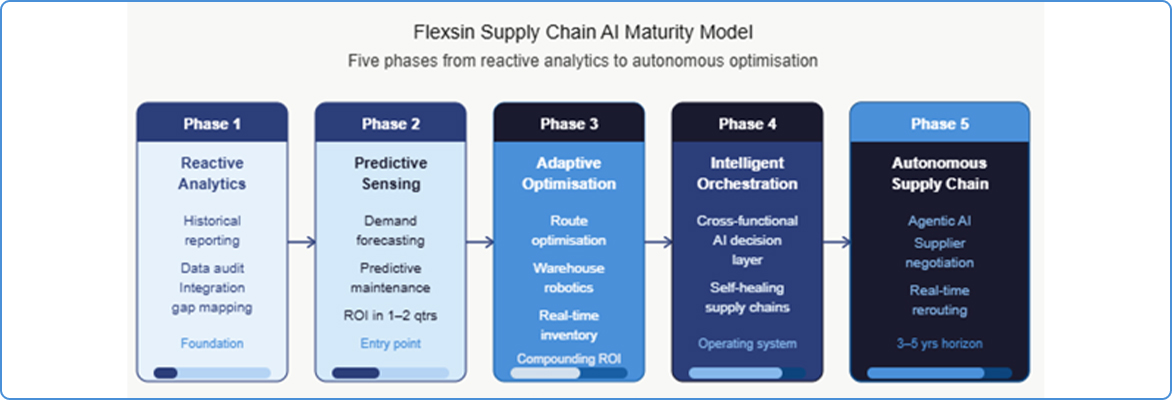
The right way to sequence AI in logistics integration is not to chase the most impressive use case first. It’s to build the data and decision infrastructure in the order that compounds. Here is the five-phase model Flexsin applies across enterprise supply chain AI engagements.
Phase 1 – Reactive Analytics
This is where most organisations already live: historical reporting, manual dashboards, Excel-driven planning. The goal in Phase 1 is not to add AI – it’s to inventory data assets, identify integration gaps, and establish baseline measurement. Every later phase depends on this groundwork being honest.
Phase 2 – Predictive Sensing
Demand sensing and predictive maintenance are the canonical entry points. They’re high value, the data inputs are relatively structured, and outcomes are measurable within a quarter. McKinsey research confirms that companies implementing AI-driven demand forecasting reduce errors by up to 50%. That’s a short enough timeline to prove ROI internally – which is what earns budget for Phase 3.
Phase 3 – Adaptive Optimization
Route optimization, warehouse robotics, and real-time inventory positioning operate at this level. UPS’s ORION system – which optimizes delivery routes against 58 variables including real-time traffic, weather, and package priority – is the canonical proof point. UPS estimates reducing just one mile per driver per day saves $50 million annually. That scale of return only works at Phase 3 because Phases 1 and 2 created the data substrate to run the optimization against.
Phase 4 – Intelligent Orchestration
At this level, AI connects procurement, logistics, and customer fulfilment into a single decision layer. It stops being a tool. It becomes an operating system. The World Economic Forum’s research on ‘self-healing supply chains’ – systems that identify disruptions and activate contingency plans without human intervention – describes Phase 4 capability in practice.
Phase 5 – Autonomous Supply Chain
At the top of the maturity model sits fully agentic AI: systems that negotiate with suppliers, reroute shipments, and adjust production schedules in real time without human authorization at each decision point. Gartner identifies agentic AI as the leading supply chain technology trend currently, with early deployments already live in automotive and fast-moving consumer goods sectors. Most Enterprise Solutions are 3 to 5 years from this phase. The ones moving fastest got their data foundations right at Phase 1.
Flexsin’s Position on AI in Logistics
Most AI development services get this backwards – they invest in AI models before they’ve solved the data architecture that makes those models trustworthy. Flexsin’s supply chain AI practice starts with a structured readiness audit: mapping data assets, integration gaps, and organizational decision rights before a single model is scoped. For a mid-size US-based industrial distributor with 14 warehouse locations, that audit surfaced three incompatible inventory data schemas producing a 23% demand forecast error before any AI was introduced. Resolving the data layer – not adding models – cut that error to 8% within two quarters.
What that engagement confirmed – and what we’ve seen repeated across retail, healthcare, and manufacturing clients – is that the AI in logistics opportunity is real, but it’s accessed through infrastructure discipline, not model sophistication. Flexsin’s Digital Transformation Services are built around this sequence: data readiness first, then predictive sensing, then adaptive optimization. The clients who follow this path don’t just run better pilots. They build programs that the organization actually scales.
What Good Logistics AI Looks Like:
Named outcomes give this framework its credibility. Consider the following benchmarks, drawn from organizations that executed the maturity sequence correctly.
Ocado’s automated warehouse in Erith, North London, runs 3,000 robots coordinated by a machine-learning system that sorts, picks, and packs items for grocery delivery. The result: 50 items picked every five minutes, food waste reduced to 0.5% against an industry average of 3 to 5%. DHL’s route optimization engine – analyzing 58 parameters per delivery – has achieved a 15% reduction in vehicle miles and a 10% drop in carbon emissions. Siemens’ predictive maintenance models, applied to logistics infrastructure, cut maintenance costs 8 to 12% over traditional scheduled maintenance and up to 40% versus reactive repair.
The pattern is consistent across sectors and geographies: the organizations delivering these outcomes didn’t start with the most advanced model. They started with the most honest assessment of where their data actually stood.
The Benefits and Limitations of AI in Logistics
AI in logistics doesn’t guarantee a return on investment, and claiming otherwise would be misleading. The average enterprise-grade AI logistics platform costs between $500,000 and $2.5 million to implement, with ongoing maintenance adding 15 to 20% of that figure annually. Gartner’s research shows that 62% of supply chain AI initiatives exceed their budgets by an average of 45%, primarily because of unforeseen data preparation and integration work – exactly the Phase 1 debt that organizations skip.
Workforce adoption remains the highest-risk variable. That 72% failure-from-resistance figure from Deloitte isn’t an edge case – it’s the mode. Organizations that allocate less than 15% of their AI project budget to training and change management report adoption rates 2.8 times lower than those that do. And cybersecurity exposure is real: AI-managed supply chains experienced 47% more cyberattack attempts in recent years compared to traditional systems, according to World Economic Forum research. These aren’t reasons to avoid AI in logistics. They’re the specific risks a credible program has to price in from day one.
People Also Ask:
What is AI in logistics and supply chain management? AI in logistics uses machine learning and predictive analytics to improve demand forecasting, route planning, and warehouse automation. It enables real-time decisions for enterprise AI supply chain at speeds and data volumes that manual methods can’t match.
Why do most logistics AI projects fail to scale? Most logistics AI programs stall due to data quality debt, workforce resistance, and integration gaps before model deployment. Building projects without a unifying strategy creates technical debt that blocks scale.
What are the best use cases for AI in logistics?Demand forecasting, predictive maintenance, and route optimization lead with structured data inputs and measurable outcomes within quarters. Warehouse automation and last-mile delivery deliver larger returns but need more mature data infrastructure.
How long does it take to see ROI from supply chain AI? Organizations with strong data foundations typically see ROI from predictive sensing within one to two quarters. Full program ROI across optimization phases typically follows within 18 to 36 months.
Flexsin’s AI and Advanced Analytics practice helps logistics and supply chain organizations move from disconnected AI pilots to programs that scale. Our engagements start with a structured data readiness audit – not a model pitch – so your AI investment lands on a foundation that compounds.
Ready to map your supply chain AI maturity and sequence your investments for maximum ROI? Connect with Flexsin’s enterprise AI integration team through our contact page.
What Leaders Ask Us
1. What does supply chain AI integration actually mean for a mid-market logistics company? AI in logistics means using machine learning to forecast demand, optimize delivery routes, and predict equipment failures before they disrupt operations. The scale of benefit depends on data readiness, not company size.
2. How is AI demand forecasting different from traditional statistical forecasting? AI demand forecasting ingests multiple real-time data streams – social signals, weather, promotional calendars, supplier lead times – simultaneously. Traditional statistical models work from historical sales data alone and can’t adapt in real time.
3. What is predictive maintenance in logistics?Predictive maintenance uses sensor data and machine learning to identify equipment failure signals before breakdown occurs. It cuts costs 8 to 12% versus traditional maintenance schedules and up to 40% versus reactive repair.
4. How much does it cost to implement AI in a logistics operation?Enterprise AI logistics platforms typically cost $500,000 to $2.5 million, plus annual maintenance at 15 to 20% of that. Scoping data readiness accurately before implementation prevents the budget overruns that affect 62% of programs.
5. What is route optimization AI and how does it reduce logistics costs? Route optimization AI analyses traffic, weather, delivery windows, and vehicle capacity in real time to generate efficient delivery routes. UPS estimates that reducing one mile per driver per day saves $50 million annually.
6. How does warehouse automation AI work? Warehouse and supply chain AI coordinates robotic picking, inventory tracking, and damage detection via computer vision and machine learning. Ocado’s system picks 50 items per five minutes, cutting food waste to 0.5% against a 3 to 5% industry average.
7. What is last-mile delivery AI?Last-mile AI optimizes the final leg of delivery using real-time routing, traffic data, and customer availability signals. It can also include autonomous robots for short-distance delivery in controlled environments.
8. What is a supply chain AI maturity model? A supply chain AI maturity model maps an organization’s progression from reactive analytics to autonomous optimization across defined phases. It guides investment sequencing so each phase builds on the data and capability of the previous one.
9. How does AI reduce supply chain disruption risk? RAI monitors supplier performance, external risk signals, and demand shifts continuously to flag disruption risk before it materializes. Toyota’s supply chain risk AI detects potential disruptions with 91% accuracy, allowing alternative sourcing with days of advance notice.
10. What are the biggest risks of implementing AI in logistics? The primary risks are data quality gaps, workforce adoption failure, integration complexity, and cybersecurity exposure. Organizations that budget for change management and data engineering alongside model development report significantly higher success rates.
