

 +1.844.3539.746
 info@flexsin.com
Why Most GCC Strategies Stall – and What the Top 10% Do Differently
 Munesh Singh
Let's talk
Table of Contents:
- What You Should Know First
- The Counterintuitive Truth About GCC Setup Value
- Where Enterprise GCC Setup Programs Most Commonly Break Down
- The Flexsin GCC Setup Strategic Readiness Framework
- Flexsin’s Position on Customized GCC Setup
- Proof Points of India GCC Setup
- GCC Setup: Key Challenges to Navigate
- People Also Ask
- Questions We Hear Most
Over 1,800 Global Capability Centers currently operate in India, employing nearly two million professionals. Seventy percent of Fortune 500 companies run at least one. And yet, most of them are underdelivering. Not on headcount, on strategic output. That gap between center presence and center performance is the real GCC problem that executives are now being asked to solve.
The GCC conversation shifted around 2020. Before that, the dominant logic was simple: move work offshore, reduce cost, maintain service levels. The pandemic complicated that equation in ways most organizations didn’t anticipate. Remote-first delivery proved that geography mattered less than execution architecture. Centers that had already been given strategic mandates – product ownership, AI engineering, data governance – outperformed their peers by a margin that showed up in board-level metrics, not just operational dashboards.
Here’s what nobody says out loud about global shared services: most GCC operating models were never designed to evolve. They were designed to deliver. The organizations that figured out the difference early own real innovation capability today. The ones that didn’t are now paying IT consulting firms to help them figure out what went wrong.
This article examines the structural decisions related to GCC maturity model and enterprise GCC strategy that separate high-performing GCCs from expensive support offices, and the framework Flexsin uses to close that gap.
What You Should Know First
Five things that matter before anything else in this article:
- The global GCC services market was valued at USD 172 billion in 2024 and is projected to surpass USD 400 billion by 2032, growing at 13.51% CAGR – the scale of this opportunity is no longer speculative.
- India hosts roughly 53% of the world’s GCCs, with Bengaluru, Hyderabad, Delhi NCR, Mumbai, Pune, and Chennai accounting for over 90% of total centers.
- GCC digital transformation models that moved from cost-center mandates to engineering and innovation ownership report 3x faster innovation cycles compared to traditional offshore delivery models.
- Only 5% of India’s GCCs are classified as mega GCCs yet they employ nearly half the total GCC workforce, confirming that strategic scale compounds over time.
- As of 2025, 83% of managed GCC models are already working with Generative AI solutions, and 58% have invested in Agentic AI – the technical baseline has shifted faster than most setup frameworks anticipated.
Those five points set the stakes for global shared services. Everything below addresses how to position a GCC to capture them.
The Counterintuitive Truth About GCC Setup Value
Cost reduction is not why high-performing global capability centers India are valued. That claim runs against every pitch deck in the market but the evidence is consistent. When McKinsey analyzed the GCC maturity model curve, the centers that delivered the highest ROI were the ones that replaced cost-arbitrage mandates with ownership mandates. The cost savings followed as a consequence, not a cause.
The more interesting pattern is what happens in year three. GCC maturity models that start as support functions either plateau or expand their mandate by engineering leadership transfer. The ones that plateau become budget lines. The ones that expand become competitive assets. A mid-size US financial services firm that set up a 400-person managed GCC model in Hyderabad for back-office operations found, by year four, that its India team was running full product cycles for two core digital banking products, and that its US headcount in those functions had not grown in three years. That is what mandate evolution looks like in practice.
The talent picture of GCC, Nodia, India, reinforces this. GCC talent India STEM pipeline produces the most engineering graduates of any country globally, and global leadership roles from India-based GCCs have grown at roughly 40% CAGR over the past five years. The leadership depth is there. The question is whether the setup model lets it be used.
Where Enterprise GCC Setup Programs Most Commonly Break Down
Most GCC operating model programs stall at the same structural point. Not setup – execution handoff.
The setup phase of global shared services is well-understood. Legal entity formation, location selection, infrastructure procurement, initial hiring, these are solvable problems. What becomes hard is the transition from partner-managed operations to self-sustaining capability. Organizations underestimate the governance infrastructure required to run a global capability center India as a true enterprise extension rather than a delivery vendor with badges.
The Three Most Common Failure Patterns of GCC Setup
Each of these shows up in roughly the same form regardless of industry or center size:
- Mandate ambiguity at launch of GCC digital transformation initiative. The GCC was told to ‘support global operations.’ That language gives a team no basis to make ownership decisions, hire for the right seniority level, or set meaningful KPIs. The result is a center staffed for execution that gets frustrated when it isn’t invited to design.
- Governance frameworks built after the fact. Access controls, IP protection, data residency policies, and compliance frameworks added six months post-launch create technical debt that grows with headcount. A 50-person team of enterprise innovation hub India can work around gaps. A 300-person team cannot.
- Hiring for cost, rather than capability at the senior layer of GCC Noida India model. Junior-heavy managed GCC model teams deliver junior-level output. The cost looks good in year one for Captive Center India setup. The capability ceiling shows up in year two. Organizations that underfund senior engineering and GCC consulting services India at launch consistently spend more to retrofit it later.
The reason these patterns persist is that most GCC advisory frameworks address the setup problem well and the evolution problem poorly. What enterprises need is an offshore captive center readiness model that works across both phases.
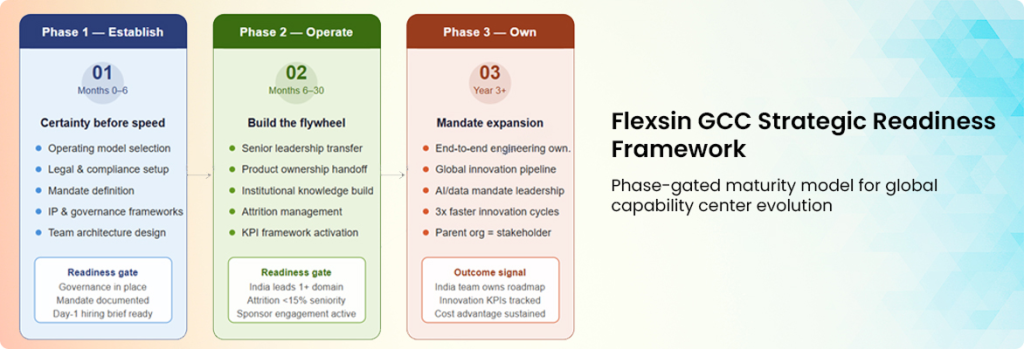
The Flexsin GCC Setup Strategic Readiness Framework
Flexsin structures global capability center India engagements around a three-phase offshore captive center model: Establish, Operate, Own. Each phase of India delivery center has specific governance triggers, capability thresholds, and leadership transition criteria that determine when the center is ready to move forward, not a timeline, but a readiness standard.
Tier 1 – Establish: Certainty Before Speed
The Establish phase prioritizes three decisions before any hiring begins: operating model selection (Managed GCC, Build-Operate-Transfer GCC, or Captive), legal and compliance architecture, and mandate definition. Mandate definition is the most consequential decision in the entire GCC lifecycle. GCC digital transformation centers that start with ‘support’ mandates rarely self-correct later. Centers that start with engineering ownership mandates build operate transfer GCC toward it naturally.
- Legal entity setup and regulatory compliance aligned to India GCC norms
- Physical infrastructure with controlled access and operational continuity – Flexsin operates from a fully owned 15,000+ sq. ft. dedicated GCC Noida India facility.
- Role-based team architecture separating leadership, core engineering, enablement, and scale layers
- Access governance and IP protection frameworks embedded before day one
Tier 2 – Operate: Build the Flywheel
The Operate phase of global shared services is where most GCC operating models stall, because ‘operate’ is interpreted as ‘maintain steady state.’ What it actually requires is active capability expansion: moving senior engineering leadership from onsite to India-based, transferring product ownership of defined functions, and building the institutional knowledge that makes the center resilient to attrition. This phase typically runs 12 to 24 months for a mid-size center.
Tier 3 – Own: The Mandate Expansion
The Own phase of the global in-house center is where the global capability center India becomes a genuine competitive asset. India-based teams own engineering mandates, lead product decisions for defined domains, and contribute to global innovation pipelines. The parent organization’s value from the GCC operating models at this stage is not cost – it’s speed. Centers at Phase 3 maturity deliver three times faster innovation cycles than centers still operating at Phase 1 mandates.
The framework’s insight is not the phases themselves – maturity models are common. The insight is that phase transitions are governed by readiness criteria, not time. Forcing a center into Phase 2 before its governance infrastructure can support it creates the failure patterns described above. Patience at the right moment accelerates everything that follows.
Flexsin’s Position on Customized GCC Setup
We built Flexsin’s GCC consulting services India around a specific observation: enterprises that come to us with a vendor mindset leave with a delivery partner mindset, but the ones that achieve durable global capability center India value come in treating the setup as a structural business decision. Those are the engagements where the governance architecture, the hiring model, and the mandate definition are resolved before a single offer letter is sent. The difference in 18-month outcomes between those two starting positions is not incremental – it’s categorical.
Our 17+ year enterprise delivery legacy across product engineering, Data & AI, Cloud & DevOps, and ERP systems means we aren’t designing GCC models in theory. We’ve run the integrations, absorbed the compliance edge cases, and hired for the seniority levels that matter. A mid-size US healthcare technology company engaged Flexsin to establish a 120-person GCC in Noida for product engineering and data science. Within 14 months, the India team had taken primary ownership of two platform modules previously managed entirely from the US, ahead of the original 24-month handoff target. That outcome of enterprise GCC strategy wasn’t accidental: it was the result of the governance and mandate architecture we established on day one.
Proof Points for India GCC Setup
The global in-house centers’ market produces a lot of numbers. Fewer organizations publish what those numbers actually translate to at the operating level. Here’s what high-performing enterprise innovation hubs India look like in practice:
Engineering Ownership Transfer
A Fortune 500 manufacturing firm with a 600-person offshore captive center GCC in Bengaluru transferred full product ownership of its IoT platform to its India team in year three. That team leads architecture decisions, manages global vendor relationships for the platform, and runs the release calendar. The US team acts as a stakeholder, not an executor.
AI and Data Capability Concentration
Recent data shows 83% of GCC ecosystems 2026 are working with Generative AI solutions as of this year. The centers that move fastest aren’t the ones with the largest AI budgets, they’re the ones that gave their India data science teams direct access to production data and product roadmaps early. India delivery centers that treat AI as a separate innovation track rather than a core mandate function consistently lag by 12 to 18 months.
Talent Retention as a Structural Advantage
India GCC ecosystem 2026 attrition is real, but it’s also manageable. Centers that build role-based career ladders – separating leadership, core engineering, enablement, and scaling functions from day one report meaningfully lower attrition than centers with flat team structures. The honest answer is that most GCC attrition isn’t about compensation. It’s about career visibility.
India’s GCC operating models’ ecosystem is projected to surpass 2,200 centers by 2030, with the talent base growing to 2.8 to 3.5 million professionals. The organizations that build operate transfer GCC with the right capability architecture now will have a structural advantage in accessing that GCC talent strategy at scale.
GCC Setup: Key Challenges to Navigate
The GCC model is not a universal fit, and three genuine constraints should be part of any serious evaluation:
- Time to meaningful output. The Establish phase takes three to six months minimum. Centers that expect delivery-grade output in month two are structuring the wrong expectations. That timeline can be compressed with the right partner, but not eliminated.
- Leadership bandwidth at the parent organization. A GCC maturity model scales proportionally to the engagement of its executive sponsors. Organizations where the GCC sits below the CFO’s direct attention consistently see slower mandate evolution. The India team can only move as fast as the parent organization makes decisions.
- Compliance complexity at scale. Data residency requirements, IP ownership frameworks, and cross-border tax structures become more complex parts of the enterprise GCC strategy as the center grows. These are solvable problems but they require legal and compliance investment that some organizations underbudget at setup.
None of these constraints disqualify Captive Center India setup model. They define what the model requires to work.
People Also Ask
What is a Global Capability Center and what is the difference between GCC vs outsourcing?
A GCC is a wholly owned subsidiary of the parent company, providing full operational control over talent, IP, and governance. Outsourcing transfers those responsibilities to a third-party vendor.
Why is India the most popular location for GCC setup?
The country hosts over 53% of the world’s India GCC ecosystems, backed by the largest STEM talent pipeline globally and a mature GCC operating ecosystem. Government-supported SEZs and improving infrastructure reinforce that advantage.
How long does it take to set up a GCC in India?
The Establish phase typically takes three to six months for legal, infrastructure, and initial hiring. Operational readiness for core delivery functions follows in months nine to twelve.
What is the difference between a Managed GCC Setup and a Build-Operate-Transfer model?
A Managed GCC has a partner running operations while the enterprise retains strategic control. A BOT model transfers full ownership to the enterprise after an agreed operational period.
Ready to build a GCC that owns capability – not just headcount?
Flexsin’s GCC practice combines 17+ years of enterprise delivery depth with a fully owned Noida facility, proven compliance architecture, and structured mandate-first onboarding. We work with mid-to-large enterprises across the US, Europe, and the Middle East to establish India delivery centers designed to scale from operational support to engineering ownership. Talk to Flexsin’s GCC team.

Flexsin’s end-to-end GCC setup designed for control, efficiency, and global growth.
Questions We Hear Most
1. What does a Global Capability Center actually do? A GCC manages functions such as product engineering, AI, data analytics, finance, HR, and customer operations. Modern centers own end-to-end mandates rather than performing back-office support.
2. Is a GCC Setup the same as a shared service center? Not exactly. Shared service centers consolidate transactional functions. GCCs are broader: they can include innovation, R&D, and product ownership in addition to shared operations.
3. How much does it cost to set up a GCC in India? Setup costs vary significantly by size, model, and location. A 50-person managed GCC in a Tier-1 city runs differently from a 300-person captive center. Engage a partner early to model total cost of ownership accurately.
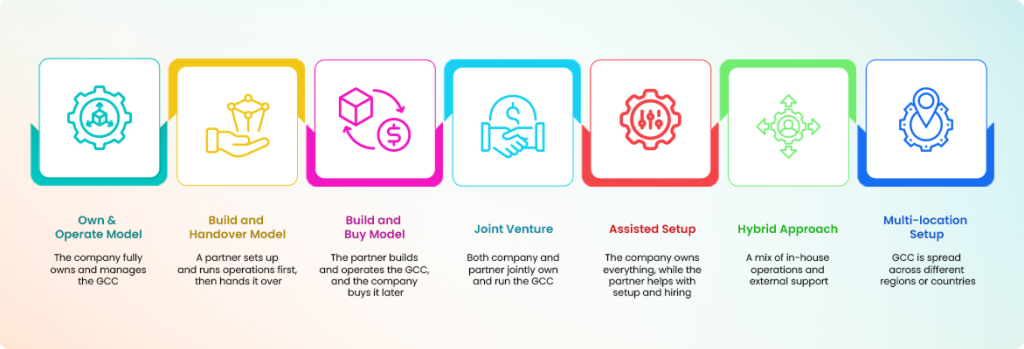
4. Which GCC Setup operating model is right for my enterprise? The Managed GCC suits organizations wanting speed with lower initial risk. BOT suits those planning full ownership within three to five years. Pure captive suits organizations with in-country execution capability already in place.
5. What functions can a GCC Setup in India support? GCCs support IT, product engineering, data science, finance, HR, procurement, legal, and customer operations. High-maturity GCC centers also run AI engineering and global product delivery.
6. How do I protect intellectual property in an India GCC? IP protection requires access governance frameworks, employment contracts with IP assignment clauses, and data security protocols embedded before any technical work begins. Post-setup retrofits create costly gaps.
7. How is the global capability center market growing? The global capability center services and GCC market size market 2032 is projected to reach over USD 400 billion, growing at a 13.51% CAGR from USD 172 billion in 2024. India alone is expected to host 2,200+ centers by 2030.
8. Can small and mid-size enterprises set up a GCC? Yes. Managed GCC and BOT models lower the initial capital and operational complexity. Mid-market firms in the 500 to 5,000 employee range are actively establishing centers today.
9. What cities in India are best for GCC setup? Bengaluru leads with 880+ centers, followed by Hyderabad at 355+. Delhi NCR, including Noida, offers strong infrastructure, competitive real estate, and access to northern India’s engineering talent pool.
10. How do I measure GCC setup’s performance beyond cost savings?High-performing GCCs are measured on engineering output velocity, innovation contribution, leadership depth (global roles owned from India), and attrition rates by seniority band. Cost is a baseline, not a ceiling.
