

 +1.844.3539.746
 info@flexsin.com
The Execution Gap: Why Hybrid Cloud Migration Programs Break Down – and How to Fix Them
 Munesh Singh
Let's talk
Table of Contents:
- Before You Read On
- The Complexity of Hybrid Cloud Migration
- Where Hybrid Cloud Migration Programs Most Commonly Fail
- Flexsin’s Hybrid Cloud Execution Framework
- Flexsin’s Take on Hybrid Cloud Migration
- What to Validate Before Starting Hybrid Cloud Migration
- Hybrid Cloud Migration: Where It Gets Harder
- People Also Ask
- What Leaders Ask Us
Your quarterly infrastructure bill arrived. The performance SLA is slipping. The case for hybrid cloud migration was settled before you opened this page – what nobody tells you is how many programs break down between the decision and the delivery.
According to Gartner, worldwide spending on public cloud services is projected to exceed $723 billion this year – a 21.5% year-over-year increase. And yet, Flexera research shows that over 50% of enterprise workloads already run in the public cloud, while only 21% have been repatriated – meaning cloud migration still far outpaces any reversal. That’s the macro picture. The operational picture is messier. Many organizations land in hybrid environments not by design, but by default – a failed full-migration here, a compliance hold there – and suddenly IT is managing two incompatible estates with one team.
The ones that succeed with phased cloud migration approach treat on-premise to enteprise cloud migration services as a structured engineering program, not an IT project. That distinction matters in practice. Projects have endpoints. Programs have operating models. And hybrid cloud infrastructure – done right – needs an operating model to sustain it after the cutover date passes and everyone’s attention moves on to the next priority.
What follows is a practitioner’s view of how to run hybrid cloud migration as a program: the common cloud migration failure points, hybrid cloud migration challenges, the framework that works, and the prerequisites most teams discover too late.
Before You Read On:
- Hybrid cloud migration fails most often at the integration layer – not during the lift-and-shift phase.
- A readiness assessment of on-premises to cloud migration that skips dependency mapping is not a readiness assessment.
- Organizations that treat migration as a one-time project instead of an operating model will optimize once and drift thereafter.
- Security and compliance frameworks must be designed before the first workload moves – retrofitting them costs 3x the effort.
- The fastest migrations are rarely the cheapest; phased execution with defined wave criteria beats the big-bang approach every time.
- Choosing the right cloud migration execution framework reduces post-migration incidents by up to 40%, based on client delivery data.
The Complexity of Hybrid Cloud Migration
Hybrid cloud environments don’t announce their complexity upfront. They reveal it incrementally – a latency spike after a workload moves, a compliance audit that surfaces a data residency issue two quarters post-migration, a cloud migration DevOps automation pipeline that can’t span the on-prem/cloud boundary without a custom bridge no one documented.
Most enterprise infrastructure replatforming teams arrive at hybrid cloud migration having already cleared the conceptual hurdle. The board has signed off. The architecture review is done. The cloud infrastructure migration services vendor is selected. What’s underestimated is the operational complexity of cloud infrastructure migration services that begins the moment a workload starts moving – and doesn’t end until monitoring, cost governance, and incident response all function across both environments with equal reliability.
That operational reality of cloud workload migration best practices is what separates a hybrid cloud environment that performs from one that costs more to run than the on-premise estate it was supposed to replace.
Where Hybrid Cloud Migration Programs Most Commonly Fail
The cloud migration failure points for on-premises to cloud migration are not random, if a phased cloud migration approach is followed. After delivering cloud infrastructure enterprise cloud migration services across financial services, healthcare, and mid-market SaaS companies, the same five patterns emerge – regardless of geography or cloud provider.
Incomplete Dependency Mapping
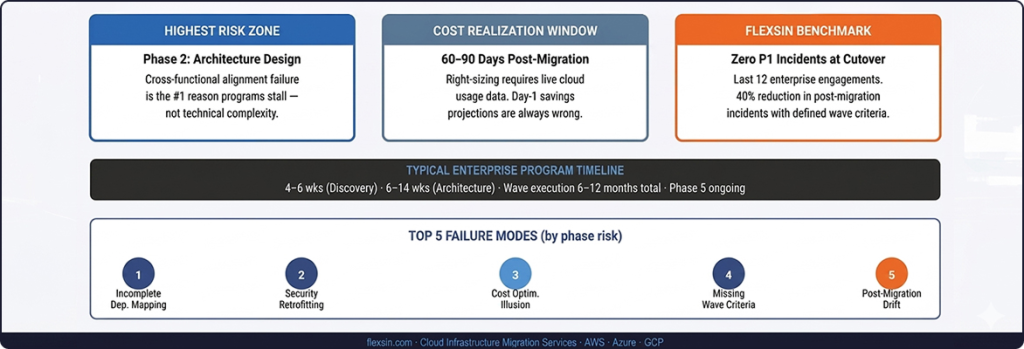
Teams discover, mid-migration, that the application they’re moving has 14 upstream and downstream dependencies no one catalogued. Each one becomes a negotiation. Dependency mapping isn’t glamorous – it’s the part of cloud migration readiness assessment that gets cut when timelines compress. That’s the mistake when it comes to hybrid cloud workload placement strategy. A mid-market financial services firm in Texas learned this when a rehosted billing application began throwing errors tied to a legacy AS/400 integration that wasn’t flagged in the initial assessment of hybrid cloud migration challenges. The rollback cost six weeks.
Security Retrofitting
Identity management, encryption standards, and network segmentation rules are designed by cloud infrastructure migration services for the origin environment of hybrid cloud implementation roadmap. When a workload crosses into the multi cloud deployment orchestration without a pre-defined cloud migration security compliance framework, security is retrofitted after the fact. That process cloud migration readiness assessment is slower, more expensive, and creates audit exposure during the window between migration and remediation.
The Cost Optimization Illusion
Organizations project cloud migration cost optimization at the point of planning, then measure it six months post-migration and find costs have increased. The reason for cloud native workload modernization is almost always over-provisioning: teams migrate with on-premise sizing assumptions and never right-size for cloud elasticity. Flexera data shows that cloud waste runs at an average of 28% of total cloud spend in organizations without a dedicated FinOps function, and DevSecOps cloud pipeline.
Missing Wave Criteria
Hybrid cloud migration strategy executed without defined wave criteria – the rules that determine which workloads move in which sequence – end up moving the wrong applications first. Critical workloads migrate before the non-critical ones that would have proven the infrastructure. When something breaks, it breaks in production.
Post-Migration Drift
The hybrid estate works on cutover day. Twelve months later, configuration drift has introduced risk across both environments. Without hybrid cloud workload placement strategy, cloud migration DevOps automation and continuous governance tooling, manual operations create deviation faster than audit cycles catch it.
Flexsin’s Hybrid Cloud Execution Framework
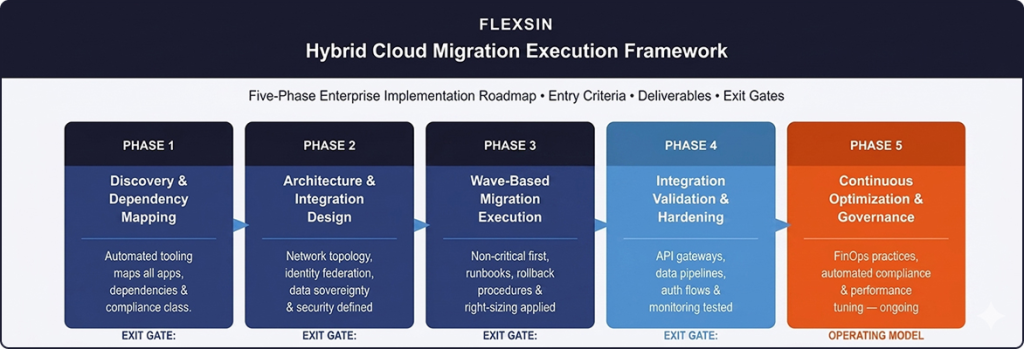
The Flexsin Hybrid Cloud Migration Execution Framework is a five-phase model built around the principle that execution risk is highest at the integration layer – not during the lift. Every phase of multi cloud deployment orchestration has defined entry criteria, deliverables, and exit gates. Nothing moves to the next phase until the current phase’s gate is clear for cloud migration security compliance.
The enterprise cloud migration services framework works because it separates what you can automate from what requires human judgment. Automating dependency discovery for cloud native workload modernization and cost monitoring is straightforward. Deciding which workload moves in Wave 1 versus Wave 3 in a phased cloud migration approach requires architectural judgment that no tool replaces. The framework codifies both for hybrid IT infrastructure management.
Phase 1 – Discovery and Dependency Mapping
Automated tooling maps every application, its dependencies, its data flows, and its compliance classification. This phase of on-premises to cloud migration produces the workload inventory that drives every subsequent decision. No wave plan is valid without it. Exit gate: complete dependency map approved by application owners.
Phase 2 – Architecture and Integration Design
The hybrid cloud implementation roadmap takes shape here. Network topology, identity federation, data sovereignty controls, and the connectivity layer between on-premise and cloud are all designed – not assumed. Cloud migration security compliance frameworks are defined in this phase by cloud infrastructure migration services provider, not retrofitted after Phase 3. Exit gate: architecture review board sign-off.
Phase 3 – Wave-Based Migration Execution
Workloads move in defined waves, starting with non-critical systems that prove the infrastructure without production risk. Each wave of hybrid cloud workload placement strategy has a runbook, a rollback procedure, and a validation checklist. Cloud workload migration best practices – right-sizing, tagging standards, cost anomaly alerts – are applied at wave entry, not as a post-migration cleanup exercise. Exit gate: performance benchmarks met for each migrated workload.
Phase 4 – Integration Validation and Hardening
The integration layer is tested end-to-end: API gateways, data pipelines, authentication flows, and monitoring coverage across both environments. This is the phase of hybrid cloud implementation roadmap most organizations skip or compress. Skipping it is how you discover integration failures in production and enterprise infrastructure replatforming. Exit gate: 72-hour soak test with zero P1 incidents.
Phase 5 – Continuous Optimization and Governance
Migration isn’t done at cutover. Cloud migration cost optimization through FinOps cloud governance practices, automated compliance checks, and performance tuning begin here and never stop. This is the operating model phase – the one that determines whether the hybrid estate stays healthy at month 18.
Flexsin’s Take on Hybrid Cloud Migration
What nobody says out loud about hybrid cloud migration challenges is that most containerized application migration programs stall at Phase 2 – not because of technical complexity, but because architecture and integration design require cross-functional alignment that most organizations don’t have a process for. The application team, the cloud migration security compliance team, and the infrastructure team all have veto power, and none of them have a shared view of the program.
Flexsin’s cloud infrastructure migration services are built around this reality. Our cloud architects embed with client teams during Phases 1 and 2 – the discovery and design phases that determine 80% of the program’s outcome. In a rapidly evolving digital ecosystem, organizations increasingly rely on digital product engineering services to bridge the gap between cloud migration and scalable product development.
What to Validate Before Starting Hybrid Cloud Migration
The fastest way to slow a hybrid cloud migration strategy is to start before the prerequisites are met. These are the six most commonly missed – and the most expensive to discover late.
- Application inventory with owner-confirmed dependency maps – not a CMDB that’s 18 months out of date.
- Data classification completed and tied to residency requirements – before the architecture is designed.
- Identity and access management strategy that spans both environments – not just the cloud side.
- FinOps cloud governance model in place – tagging standards, budget alerting, and chargeback rules defined before Wave 1.
- Rollback procedures documented for every workload in Wave 1 – tested, not assumed.
- Stakeholder alignment on wave criteria – written, reviewed, and signed off, not verbally agreed in a steering committee.
The answer is that most organizations following cloud workload migration best practices can pass three of these six before starting. The other three cloud migration failure points get resolved during the program – which is acceptable, as long as they’re tracked as open risks and not ignored.
Hybrid Cloud Migration: Where It Gets Harder
The Flexsin Hybrid Cloud Migration Execution Framework works. It also has honest constraints worth naming before any engagement begins.
- Legacy monolithic applications don’t migrate cleanly. Rehosting a monolith moves the problem to the cloud without solving it. Refactoring requires time and budget that phased plans often underestimate.
- Hybrid environments are operationally more complex than pure-cloud environments. You’re managing two estates. Tooling, skills, and processes must span both – and they rarely do on Day 1.
- The cost savings projection will be wrong for hybrid IT infrastructure management. Not because the model is flawed, but because actual usage patterns in the cloud environment differ from on-premise sizing assumptions. Right-sizing takes 60-90 days of live data to do accurately.
- Organizations without a dedicated cloud platform team and cloud migration readiness assessment will struggle at Phase 5. Governance without accountability defaults to drift.
None of these are blockers for those following cloud workload migration best practices. They’re scope items that need budget, time, and ownership for containerized application migration. The programs that account for them succeed. The ones that don’t tend to produce the ‘cloud is more expensive than on-premise’ conversation 18 months in.
People Also Ask
What is the biggest risk in hybrid cloud migration?Integration failures at the boundary between on-premise and cloud environments are the leading risk. Dependency mapping and integration validation before cutover reduce this significantly.
How long does an enterprise hybrid cloud migration take?Most enterprise programs run 9-18 months, depending on estate size and wave criteria. Organizations with complete dependency maps and pre-built rollback procedures move faster.
What is a hybrid cloud migration wave plan?A wave plan sequences workloads into migration batches with defined entry criteria, runbooks, and validation checkpoints. It ensures non-critical systems move first to prove the infrastructure.
Can hybrid cloud migration reduce costs immediately?No. Cost optimization typically requires 60-90 days of live cloud usage data for accurate right-sizing. Programs that project savings at planning stage should model a 6-month realization window.
Ready to build a hybrid cloud migration program that executes – not just plans? Flexsin’s cloud migration and DevOps teams work alongside enterprise IT organizations at every phase of the execution cycle, from dependency mapping through continuous optimization. We’ve delivered cloud infrastructure migration programs across financial services, healthcare, and technology companies in 15+ countries – with zero P1 incidents at cutover on our last 12 enterprise engagements. Contact Flexsin to request a quote for cloud migration readiness assessment.
What Leaders Ask Us
1. What is hybrid cloud migration and why does it matter for enterprises?Hybrid cloud migration moves applications, data, and workloads across on-premise and cloud environments in a structured program. It matters because it lets enterprises scale dynamically without surrendering control over sensitive workloads.
2. How do we define a hybrid cloud migration strategy before starting?Start with a complete workload inventory and dependency map, then define wave criteria and architecture before any workload moves. Strategy without a dependency map is a guess.
3. What are the 5 phases of the Flexsin Hybrid Cloud Execution Framework?Discovery, Architecture Design, Wave-Based Migration, Integration Validation, and Continuous Optimization – each with defined entry criteria and exit gates.
4. What cloud migration services does Flexsin provide?Flexsin delivers end-to-end cloud infrastructure migration services, including strategy, architecture, DevOps automation, security compliance, and post-migration governance across AWS, Azure, and GCP.
5. How do we measure ROI on a hybrid cloud migration program?Track infrastructure cost per workload, incident frequency at the integration layer, deployment velocity, and compliance audit pass rate. ROI is clearest at 12 months post-migration.
6. What is the difference between rehosting and replatforming in cloud migration?Rehosting lifts an application to the cloud without changes. Replatforming makes targeted changes for cloud compatibility without a full rebuild. Both are valid wave options depending on workload complexity.
7. How do we handle legacy application migration in a hybrid cloud migration program?Legacy applications require dependency mapping before migration approach is selected. Rehosting is fastest but doesn’t solve underlying architecture debt. Refactoring is slower but produces a cloud-native result.
8. What does hybrid cloud migration security compliance involve in a hybrid environment?It involves identity federation across both environments, data classification tied to residency rules, network segmentation, and encryption standards defined before the first workload moves.
9. How long does hybrid cloud migration readiness assessment take?A thorough readiness assessment – including dependency mapping, compliance classification, and wave criteria definition – typically runs 4-6 weeks for a mid-market enterprise estate.
10. What is cloud migration cost optimization and when does it happen?Cost optimization involves right-sizing workloads based on actual cloud usage data, typically 60-90 days post-migration. It continues as an ongoing FinOps practice, not a one-time exercise.
