

 +1.844.3539.746
 info@flexsin.com
What Most Joomla Teams Get Wrong When They Add AI to Their CMS
 Munesh Singh
Let's talk
The most common mistake isn’t choosing the wrong AI tool. It’s assuming that adding an AI plugin to a Joomla site is a strategy. Joomla AI integration has matured fast – the extensions are real, the framework infrastructure is arriving, and the Model Context Protocol is already enabling AI agents to manage site content through natural language.
But the gap between teams that see compounding returns and teams that see abandoned experiments comes down to one decision made before any Joomla AI integration tool is installed. This is where partnering with a digital product engineering company becomes critical to define a scalable and future-ready AI integration architecture.
What You Should Know First
- Joomla’s AI extension ecosystem can deliver immediate value – but without an abstraction strategy, every vendor switch means a rewrite.
- The Joomla AI Framework (developed during Google Summer of Code) solves provider lock-in at the infrastructure level, not the plugin level.
- AI chatbots trained on Joomla content – including HikaShop product data – can deliver genuine 24/7 support without a live agent queue.
- A Python pipeline using dlt and Joomla’s Web Services API can feed ML models with structured article and user interaction data for recommendation engines.
- The Model Context Protocol already allows AI agents like Claude to create, update, and delete Joomla content through direct API access.
- Enterprise Joomla teams that treat Joomla AI integration as a layer – not a feature – outpace those who treat it as an add-on within 12 months.
- The Counterintuitive Reality of Joomla AI Integration
The teams that get the most out of Joomla AI integration are, counterintuitively, the ones who install fewer tools. Every additional AI extension creates a dependency chain – API keys, separate configuration panels, divergent update cycles, and no shared context between the chatbot, the content assistant, and the recommendation engine. The result isn’t intelligence. It’s overhead dressed as innovation.
What’s actually happening in the Joomla ecosystem right now is more interesting than most teams realize. The Joomla AI Framework, built during Google Summer of Code, introduces an abstraction layer that sits between your extension code and any AI provider you choose. OpenAI today. Anthropic’s Claude tomorrow. A local Ollama instance for a client that won’t send data offshore. The code you write doesn’t change. That’s the difference between a feature and infrastructure.
Most Joomla CMS AI projects fail not because the tools are bad – but because the architecture was never designed to outlast the first vendor relationship.
Where Most Joomla AI Projects Stall
The pattern is consistent across mid-market Joomla deployments. A content team installs an AI writing extension, gets fast results in the first month, and then hits three compounding problems: the generated content drifts from brand guidelines, the chatbot answers questions the content team hasn’t reviewed, and there’s no mechanism to feed real user behavior back into what the AI prioritizes.
Three failure points accelerate every stall:
No feedback loop: Joomla AI integration tools are almost always output-only. There’s no connection between what the AI produces and what users actually engage with.
Provider coupling:Extensions built directly on OpenAI’s API require a full rewrite to switch providers – and clients do switch, especially as pricing models shift.
Context fragmentation:The chatbot doesn’t know what the content assistant wrote. The content assistant doesn’t know what the chatbot is answering. Neither knows what the recommendation engine is surfacing.
The honest answer is that most Joomla AI implementations are a collection of disconnected point solutions with a shared URL. That’s not a criticism of the tools – it’s a structural problem that the Joomla AI Framework is specifically designed to address.
The Flexsin CMS Intelligence Framework
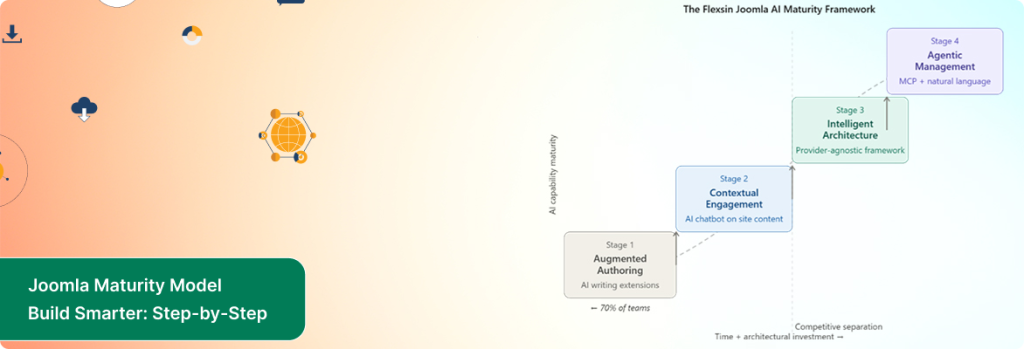
Flexsin’s Joomla AI development services enable CMS AI adoption across four stages – each with a distinct technical profile and business outcome.
Stage 1 – Augmented Authoring
The team installs content generation and proofreading extensions. Output volume increases. Quality control is manual. No data flows back into the system. This is where 70% of Joomla teams currently sit, according to patterns observed across enterprise digital experience platform AI adoption tracked by Gartner’s digital experience platform research.
Stage 2 – Contextual Engagement
A Joomla-trained AI chatbot is deployed – synchronized with article content and, where relevant, e-commerce product data. The chatbot answers accurately because it’s been trained on the site’s own material, not a generic corpus. Response accuracy improves and support ticket volume typically drops by 30–40% within 90 days for mid-market deployments.
Stage 3 – Intelligent Architecture
Developers adopt the Joomla AI Framework abstraction layer. Extensions are built provider-agnostic. A Python pipeline – using tools like dlt against Joomla’s Web Services API – begins feeding structured article and interaction data into external ML models. The recommendation engine stops being a plugin and becomes a trained model.
Stage 4 – Agentic Management
The site is exposed via an MCP server. AI agents can retrieve, draft, publish, and retire content through natural language instructions without the content team touching the CMS interface. A senior editor at a 200-person B2B SaaS company in Austin, for example, can instruct an AI agent to update all product-related articles affected by a pricing change – and the agent executes across every page in the session.
The line between Stages 3 and 4 is the one most enterprise Joomla teams aren’t planning for Joomla AI integration yet. That’s where competitive separation happens.
The Flexsin Position
Flexsin’s open-source and CMS practice has worked across Joomla deployments ranging from regional publishers to global e-commerce operations. What’s most common isn’t a technology problem – it’s a sequencing problem. Teams reach for the chatbot before they’ve audited content quality. They install content generation tools before they’ve defined brand voice rules. Joomla AI integration amplifies what’s already there, which means it also amplifies inconsistency.
The projects that compound – where AI genuinely reduces editorial overhead and improves user engagement metrics over 12 months – share one characteristic: they designed the integration architecture before selecting any tool. Provider abstraction, data pipeline strategy, and content governance rules were decided at the whiteboard, not discovered after the first vendor invoice arrived. Hire Joomla developers now to begin with a three-session architecture sprint before a single extension is evaluated.
What Good Looks Like: Named Outcomes
A 150-person e-commerce operation in the UK running Joomla with HikaShop deployed AI chatbot synchronization across 4,000 product SKUs. Within 60 days, support email volume dropped 34%. The chatbot answered order status, return policy, and compatibility questions accurately because it had been trained on the company’s own Joomla content – not a generic model.
A US-based B2B publisher with 12,000 Joomla articles built a custom recommendation engine using a dlt pipeline feeding into a scikit-learn model. Recommended article click-through rates outperformed the previous “Related Articles” plugin by 4.2x within the first quarter. The model was retrained monthly on fresh user interaction data pulled directly from Joomla’s Web Services API.
These outcomes aren’t exceptional. They’re what Stage 2 and Stage 3 look like when the architecture is right. According to AI in content operations productivity research from McKinsey & Company, organizations that integrate AI into structured workflows – rather than deploying it as standalone tools – report 3x higher productivity gains than those using point solutions.
Joomla AI Integration: Where It Gets Harder
Joomla AI integration carries real constraints that no vendor will lead with. Content quality is a prerequisite, not a parallel workstream. AI content assistants trained on poorly structured, inconsistently tagged Joomla articles will produce output that reflects those flaws at scale. Garbage in, garbage amplified.
The Joomla AI Framework, as of now, supports OpenAI and Ollama – with more providers incoming. That’s promising infrastructure, but it means teams building on it today are early adopters accepting some API surface instability. Extensions built on the framework branch will need monitoring as the API stabilizes.
Agentic content management via MCP is real, but it’s also the stage where governance breaks down fastest. An AI agent with write access to a Joomla site can publish incorrect information at speed. The operational discipline required – approval workflows, content validation rules, rollback protocols – is as important as the technical integration itself.
Headless CMS AI deployments add another layer of complexity. Teams moving toward a headless Joomla architecture while adding AI capabilities are managing two architectural shifts simultaneously. That’s not impossible, but it’s a timeline and resourcing decision, not just a technology one.
People Also Ask:
Can I add AI to Joomla without writing custom code?Yes. Extensions like AI Content Assistant and AI SmartTalk install directly from the Joomla Extensions Directory. They require only API key configuration, not development work.
What is the Joomla AI Framework and is it production-ready?It’s an abstraction layer built during Google Summer of Code that standardizes AI provider integration. As of mid-year, it supports OpenAI and Ollama with more providers coming – treat it as early-adopter infrastructure.
How does an AI chatbot on Joomla know about my specific products?Extensions like AI SmartTalk synchronize directly with your Joomla articles and HikaShop product data. The chatbot is trained on your content, not a generic model.
What is MCP and why does it matter for Joomla site management?MCP (Model Context Protocol) lets AI agents interact with your Joomla site via API. It means an AI assistant can create, edit, or delete content through natural language instructions.
Most Joomla teams evaluating AI don’t need more plugins. They need an integration architecture that doesn’t require rebuilding every time a provider changes pricing. Flexsin’s open-source and CMS practice helps mid-market and enterprise teams design Joomla AI infrastructure that compounds – from content automation through to agentic site management. If your current AI toolset feels like a collection of disconnected experiments, that’s the right time to talk architecture.
Contact Flexsin Technologies to get started with Joomla AI integration and Joomla framework.
Questions We Hear Most
1. What is Joomla AI integration?It is the process of connecting AI services for content generation, chatbots, or recommendations to a Joomla CMS through extensions or custom API integrations.
2. Which Joomla AI extensions are worth installing first?AI Content Assistant for writing and AI SmartTalk for chatbots deliver the highest ROI. Both install from the JED without custom development.
3. Does Joomla support OpenAI natively?Not natively. The Joomla AI Framework currently in development will provide native OpenAI support. Today it is handled through third-party extensions.
4. Can I use Claude or Gemini for Joomla AI integration?Yes. The Joomla AI Framework is designed as a provider-agnostic abstraction layer that will support Anthropic’s Claude, Google Gemini, and others.
5. How do I train an AI chatbot on my Joomla content?Extensions like AI SmartTalk synchronize with your Joomla articles and HikaShop product data automatically. No manual training data preparation is required.
6. Is the Joomla AI Framework free to use?It’s an open-source initiative and is free. AI provider API costs apply separately.
7. What is the Model Context Protocol in the context of Joomla?MCP is a protocol that lets AI agents interact with systems via structured API access. A Joomla MCP server allows AI assistants to manage your content directly.
8. How much does Joomla AI integration cost for a mid-market site?Extension costs are typically $50–$300 per year. Custom AI pipeline development ranges from $15,000–$60,000 depending on scope and data volume.
9. What are the security risks of Joomla AI integration?Primary risks include insecure API key storage and insufficient server-side data validation. All integrations should run over HTTPS with keys stored outside public directories.
10. Can AI replace a Joomla content team?No. Joomla AI integration accelerates content production and reduces repetitive tasks. Human oversight for brand accuracy, editorial judgment, and governance remains non-negotiable.
