

 +1.844.3539.746
 info@flexsin.com
Engineering a High-Availability ERP Architecture on Azure – Lessons from Production
 Sudhir K Srivastava
Let's talk
High-availability ERP architecture on Azure demands disciplined system design, ACID-compliant data modeling, role-based security, and performance engineering aligned to real business SLAs. Production success depends on balancing ERP scalability, compliance, and reliability through structured architectural decision records, measurable benchmarks, and resilient Azure ERP Hosting Solutions.
Enterprise systems fail not because of features, but because of architectural shortcuts. When we undertook a full ERP System Modernization initiative for a multi-warehouse distribution business, the mandate was clear – eliminate fragmented Excel processes, enforce financial integrity, and deliver a production-grade ERP architecture with 99.5 percent availability during business hours.
This was not a cosmetic upgrade. It was Custom ERP Development designed to consolidate Order-to-Cash, Procure-to-Pay, and inventory control into one auditable platform. This is where digital product engineering services play a critical role in ensuring scalable architecture, seamless integration, and long-term system performance.
Defining the Non-Negotiables of ERP Architecture
Before designing any enterprise platform, the foundational expectations must be clearly established. ERP systems support mission-critical financial and operational workflows, meaning the architecture must prioritize reliability, data integrity, and predictable performance from the start. These baseline requirements guide every technical decision, from infrastructure selection to database design and governance policies.
Availability, Integrity, and Compliance First
A secure and resilient ERP environment requires architecture that aligns with operational realities, regulatory expectations, and long-term scalability goals. By combining structured infrastructure design with intelligent monitoring and automation, organizations can ensure consistent performance and reliability. This approach allows ERP systems to support mission-critical workflows while maintaining compliance and operational continuity.
Before selecting tools or frameworks, we defined measurable constraints:
- 99.5 percent uptime during operating hours
- Sub-400 ms transactional latency at p95
- Strong ACID guarantees across financial workflows
- Zero tolerance for dual-entry inconsistencies
- Audit-ready data retention
High-availability ERP architecture must start with non-functional clarity. Ultimately, successful ERP modernization is built on disciplined architecture, measurable governance, and a clear understanding of enterprise workloads. Organizations that invest in scalable infrastructure, strong security frameworks, and performance-driven engineering create ERP environments that can evolve with business demands.
Why ERP Scalability Is Not Optional?
Growth projections required horizontal scaling of the application tier and reporting isolation for analytics-heavy workloads. ERP platforms must scale efficiently as transaction volumes, users, and integrations increase across the organization. Without scalable architecture, system performance degrades, reporting slows, and critical business processes become unreliable.
ERP scalability meant:
– Stateless web tier behind load balancing
– Read replicas for reporting
– Independent scaling triggers based on CPU thresholds
– Session persistence outside application memory
Azure ERP Hosting Solutions enabled elastic expansion without sticky-session constraints. By implementing structured scalability strategies, organizations ensure their ERP systems remain responsive during peak operational demand. Azure ERP Hosting Solutions support this approach by enabling flexible infrastructure that grows alongside enterprise workloads.
Architectural Decision Records and Trade-Off Governance
Enterprise ERP architecture solutions requires disciplined documentation of major technical decisions to ensure long-term system stability and accountability. Architectural Decision Records (ADRs) help engineering teams capture the reasoning, constraints, and trade-offs behind critical design choices. This structured approach ensures that future development aligns with the original architectural intent while supporting scalability and governance.
Monolith vs Microservices in ERP Architecture
One of the most debated Architectural decision records centered on decomposition strategy. Microservices promised autonomy. However, distributed transaction management introduces complexity incompatible with strict financial consistency.
We adopted a modular monolith model with clear namespace boundaries and enforced service interfaces.
Result:
– Reduced operational overhead
– Maintained ACID integrity
– Preserved future extractability
Architectural decision records created transparency for every major trade-off. By documenting these architectural trade-offs, teams maintain clarity and consistency as the ERP system evolves. Architectural Decision Records ensure that future enhancements remain aligned with performance, scalability, and financial data integrity requirements.
SQL Server as the Single Source of Truth
Another ADR evaluated data store strategy. Selecting the right data platform was critical to maintaining financial accuracy, data integrity, and long-term operational reliability within the ERP environment. Hybrid NoSQL designs risk eventual consistency issues in financial ledgers. For this ERP architecture, SQL Server on Azure provided:
- Transactional guarantees
- Managed backups
- Query Store monitoring
- Transparent Data Encryption
Custom ERP Development at scale requires consistency over experimentation. Prioritizing a centralized and reliable database architecture ensures that financial records remain consistent across all ERP processes. This approach strengthens data governance while supporting scalable and secure enterprise operations.
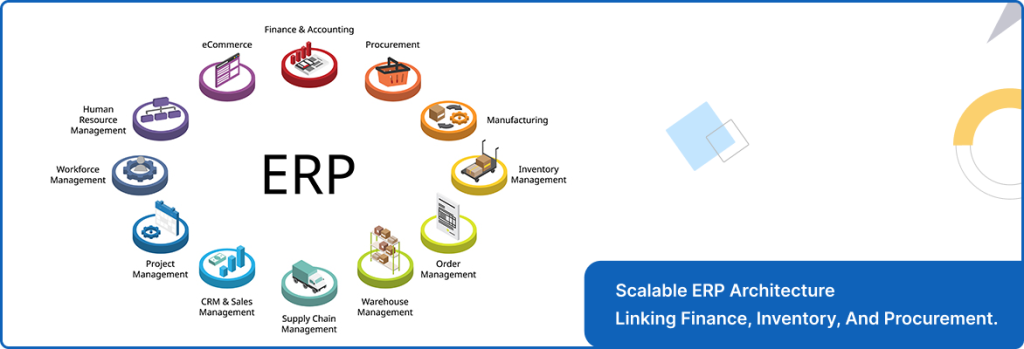
Layered Design for High-Availability ERP Architecture
The system was structured into clearly bounded layers:
Presentation – Identity – API – Business Logic – Integration – Data – Observability – Infrastructure.
Each layer owned a defined responsibility boundary. A layered architecture ensures that each component of the ERP system operates within a clearly defined functional boundary. This separation improves maintainability, strengthens fault isolation, and enables teams to diagnose performance issues more efficiently.
Benefits:
– Isolation of failure domains
– Controlled contract exposure
– Easier performance profiling
– Predictable scaling patterns
API versioning followed additive-only policies to prevent breaking consumers. Integration adapters handled SMTP, document storage, reporting engines, and push notifications with retry and circuit breaker logic. ERP Performance Optimization requires resilience patterns, not just faster servers.
Security and Zero-Trust Implementation
Security architecture was designed around a zero-trust framework where every request is verified, authenticated, and authorized before access is granted. This model ensures that internal and external users are continuously validated rather than implicitly trusted within the network boundary. By enforcing strict identity governance and access controls, the ERP system protects sensitive financial and operational data from unauthorized activity.
Identity and Access Controls
Role-based authorization governed module, entity, and field-level access.
Claims-based RBAC allowed:
- Division-level data filtering
- Controlled financial approvals
- Reduced role sprawl
Financial mutations were append-only and fully audit-logged. This security approach strengthens accountability while maintaining full visibility into financial operations. Comprehensive auditing and strict access controls ensure compliance, traceability, and protection of critical enterprise data.
Encryption and Secret Governance
Robust encryption practices protect sensitive enterprise data both in transit and at rest within the ERP environment. Centralized secret governance ensures that credentials, tokens, and encryption keys are securely stored and rotated through controlled access mechanisms. These measures significantly reduce the risk of unauthorized access, data exposure, and infrastructure compromise.
Security measures undertaken:
- TLS enforcement at gateway level
- Database encryption at rest
- Secure key vault integration
- Anti-forgery protection
- Rate limiting and lockout policies
High-availability ERP architecture without zero-trust discipline is incomplete. Ultimately, strong encryption and secret management form the foundation of secure enterprise infrastructure. When combined with zero-trust principles, they ensure that ERP systems remain resilient, compliant, and protected against evolving security threats.
Data Modeling and Financial Integrity
Immutable financial tables prevented silent ledger manipulation. Corrections were processed as reversals, not updates. Inventory reservation required atomic transactions to avoid over-allocation.
Indexing strategy included:
- Clustered primary keys
- Covering indexes for high-cardinality filters
- Pre-joined reporting views
- Query plan regression tracking
This combination drove ERP Performance Optimization from the database layer upward. This disciplined data modeling approach ensured consistent financial records and minimized the risk of transactional anomalies. Strong indexing strategies and controlled data integrity mechanisms helped sustain reliable ERP performance as system workloads expanded.
Performance Engineering Under Production Load
Load testing simulated three times peak concurrency. Performance engineering focused on validating system behavior under real-world and peak operational conditions. Rigorous load simulations ensured that the ERP platform could sustain high concurrency while maintaining stable response times and reliability.
Benchmarks achieved:
- 340 ms p95 transactional latency
- 4.8 second reporting p95 under throttle
- Error rate below 0.5 percent
Optimization case example:
An aging report initially required 18 seconds. After pre-aggregation and materialized views, latency reduced to just over 2 seconds. Inventory query scans were reduced by nearly 87 percent after composite indexing. ERP scalability is measurable, not aspirational.
DevOps, Observability, and Recovery Readiness
Modern ERP platforms require disciplined DevOps practices to maintain stability, visibility, and rapid recovery during production incidents. Observability tooling and automated deployment pipelines ensure that system behavior can be monitored continuously while updates are delivered safely. This operational framework by Azure consulting services allows teams to respond quickly to failures while preserving uptime and data integrity.
CI/CD pipelines enforced:
– Automated build and test gates
– Blue-green deployment swaps
– Rollback capability under two minutes
Observability stack comprised:
- Structured logging
- Real-time telemetry
- SLO-based alerting
- Database load monitoring
- Recovery metrics:
- RPO of one hour
- RTO of four hours
Production-grade ERP architecture must assume failure and design around it. Designing ERP systems with failure scenarios in mind ensures operational continuity even during unexpected disruptions. A resilient architecture supported by observability and rapid recovery mechanisms allows organizations to maintain reliability, protect data integrity, and sustain business-critical operations.
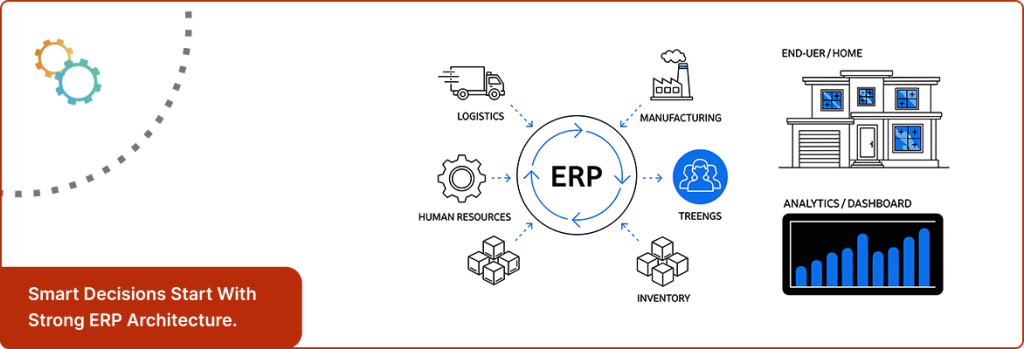
Migration from Legacy Systems
Migrating from legacy ERP systems requires careful planning to avoid operational disruption and data inconsistencies. A phased migration strategy ensures that critical business processes continue functioning while new systems are validated. Structured transition models also allow teams to detect integration issues early and maintain business continuity throughout the modernization process.
Phases of migration model:
– Data mapping and cleansing
– Parallel dual-write validation
– Controlled cutover window
– Hypercare monitoring period
Measured outcomes within six months:
- Order processing reduced by 88%
- Inventory accuracy improved by 25% points
- Report generation reduced from days to seconds
- 31% total cost reduction
- 99.6% uptime achieved
High Availability ERP System Modernization delivers value when architecture drives execution. These results demonstrate how disciplined architecture and structured migration strategies translate into measurable operational improvements. ERP modernization not only enhances performance but also strengthens data accuracy and system reliability across the organization. When executed with strong architectural governance, modernization initiatives create long-term efficiency, scalability, and business value.
Comparison Table – Basic ERP vs High-Availability ERP Architecture
| Dimension | Basic ERP | High-Availability ERP Architecture |
|---|---|---|
| Availability | Best effort | SLA-driven 99.5 percent+ |
| Data Integrity | Partial consistency | Strict ACID compliance |
| Scaling | Vertical only | Horizontal auto-scale |
| Reporting | Batch heavy | Optimized pre-aggregation |
| Deployment | Manual | Blue-green CI/CD |
Final Perspective
A resilient ERP architecture on Azure is not achieved through tooling alone. It is achieved through disciplined trade-offs, measurable performance engineering, structured Architectural decision records, and clear business SLAs. High availability, ERP scalability, and financial integrity must be engineered from day one.
If your organization is planning ERP System Modernization or seeking Azure ERP Hosting Solutions backed by real production experience, contact Flexsin Technologies. Our enterprise teams specialize in Custom ERP Development and high-availability ERP architecture built for measurable business impact.
Frequently Asked Questions
1. What defines high-availability in ERP architecture?It combines uptime guarantees, fast recovery metrics, and resilient scaling mechanisms. It also includes redundancy strategies and proactive monitoring to prevent service disruptions.
2. Why avoid microservices in ERP?Strict ACID workflows can become complex under distributed transaction models. This complexity can introduce consistency risks in financial and inventory operations.
3. How does Azure support ERP scalability?Through load balancing, auto-scaling triggers, managed databases, and secure hosting environments. These capabilities allow infrastructure resources to expand or contract based on real-time demand.
4. What role do Architectural decision records play?They formalize design trade-offs and create long-term governance clarity. This documentation also helps future teams understand the reasoning behind critical architectural choices.
5. How do you optimize ERP performance?Through indexing, pre-aggregation, query tuning, and workload isolation. Continuous monitoring and benchmarking further ensure the system performs efficiently under production workloads.
6. What is the importance of RBAC?It ensures financial data is restricted at granular levels. This prevents unauthorized access while maintaining proper operational accountability.
7. How do you prevent data corruption?By enforcing ACID transactions and immutable financial records. Strong validation rules and audit trails further protect data integrity.
8. Which industries benefit most from AI search optimization?Technology, healthcare, financial services, and consulting sectors benefit significantly due to their knowledge-driven content ecosystems. These industries often rely on authoritative content that AI systems frequently reference.
9. How should companies begin implementing an AI search strategy?Organizations should start by structuring their knowledge of architecture, improving semantic clarity, and aligning SEO, AEO search, and GEO search within a unified strategy. This approach helps ensure long-term AI content discoverability and sustainable digital visibility.
