

 +1.844.3539.746
 info@flexsin.com
Architecting a Scalable Multi-Entity D2C Enterprise Retail ERP on AWS with Odoo v18
 Munesh Singh
Let's talk
Scaling a direct-to-consumer ecosystem across multiple legal entities demands structured governance, real-time data, and cloud elasticity. A well-architected Enterprise retail ERP built on Odoo v18 and AWS enables operational unification, automated intercompany flows, and predictive control over inventory, finance, and fulfillment – without compromising flexibility or ownership.
Modern DTC enterprises rarely operate as a single legal or operational unit. They run parent entities, subsidiaries, distribution arms, and global suppliers. Sales occur across marketplaces, payment gateways, and regional storefronts. Finance teams reconcile transactions across currencies. Operations teams track shipments across carriers. When these moving parts rely on spreadsheets and disconnected tools, complexity compounds exponentially.
Architecting an Enterprise retail ERP is not a software deployment exercise. It is a structural transformation initiative. At Flexsin, we approach this as a controlled modernization journey – from process discovery to cloud-native deployment, from operational stabilization to data-driven intelligence. This is where a digital product engineering company brings strategic value by aligning ERP systems with scalable digital ecosystems and long-term business growth.
Why Enterprise Retail ERP Is Critical for Multi-Entity DTC Growth?
An Enterprise retail ERP is the backbone that integrates procurement, inventory, logistics, accounting, payments, and reporting into a unified operational layer. In a multi-entity DTC environment, this integration becomes mission critical.
Without structured ERP consolidation strategy, enterprises face:
– Intercompany transaction inconsistencies
– Duplicate data entry
– Delayed financial visibility
– Inaccurate stock forecasting
– High manual reconciliation effort
A properly architected Multi-Entity ERP Implementation eliminates these inefficiencies by enforcing standardized workflows across legal entities while preserving financial autonomy per unit.
The Hidden Cost of Fragmentation
Multi-entity DTC businesses often underestimate the compounding cost of manual intercompany purchase orders, returns, and cross-entity billing. Each manual transaction increases reconciliation time and risk exposure.
A scalable Enterprise retail ERP introduces:
– Automated intercompany purchase order creation
– Mirrored sales recognition across entities
– Synchronized inventory adjustments
– Real-time consolidated reporting
It also enables standardized governance across business units while preserving entity-level financial autonomy. More importantly, it creates a single operational truth layer that leadership can rely on for strategic planning and controlled expansion.
This forms the foundation for Digital transformation ERP initiatives at scale.
Why Odoo v18 and ERP on AWS Is a Strategic Choice?
Selecting Odoo enterprise implementation on ERP on AWS is a deliberate architectural decision. It reflects a strategic commitment to scalability, control, and long-term operational resilience rather than short-term deployment convenience.
Odoo v18 offers modular extensibility, multi-company accounting support, and ORM-driven security control. AWS provides infrastructure elasticity, isolation, and predictable scaling economics. Together, they create a resilient and future-ready Enterprise retail ERP foundation capable of supporting complex multi-entity growth without architectural rework.
Together, they enable:
- Dedicated EC2 environments for controlled deployments
- PostgreSQL optimization for performance
- VPC isolation for security governance
- S3 backup strategies for disaster recovery
- CloudWatch monitoring for operational visibility
From an ERP cost optimization strategy perspective, hosting on AWS allows infrastructure predictability compared to escalating SaaS user-based pricing models at enterprise scale.
Architectural Components of a Cloud-Native Enterprise Retail ERP
- Application Layer – Odoo v18 Enterprise
- Database Layer – Tuned PostgreSQL clusters
- Web Layer – Nginx with SSL configuration
- Storage – Encrypted S3 backups
- Monitoring – Cloud-based telemetry
- Security – Role-based multi-company access control
This architecture ensures Retail ERP modernization without sacrificing data ownership.
Automating Retail Operations at Scale
Retail operations automation is the first measurable value driver in any ERP transformation. It delivers immediate efficiency gains, reduces dependency on manual processes, and establishes a repeatable operating rhythm across entities. In high-volume DTC environments, automation directly influences speed, accuracy, and cost control.
In a DTC multi-entity environment, automation must address not just task efficiency but systemic coordination across procurement, logistics, finance, and inventory. Critical automation layers include:
- Purchase order auto-population
- Carrier rate rule engines
- Unified shipment tracking
- Automated stock adjustments
- Integrated payment reconciliation
When these components operate within a unified Enterprise retail ERP, transactional workflows become event-driven rather than manually triggered. This reduces operational friction, improves data accuracy, and creates a scalable foundation capable of supporting growing order volumes without proportional increases in headcount.
Intelligent Purchase Order Engine
A configurable rules-based module by ERP implementation consulting reduces manual entry time by over 70 percent. SKU-level intelligence can auto-populate:
– Carton dimensions
– Freight cost calculations
– Vendor pricing
– Unit cost projections
This reduces operational friction while ensuring audit traceability.
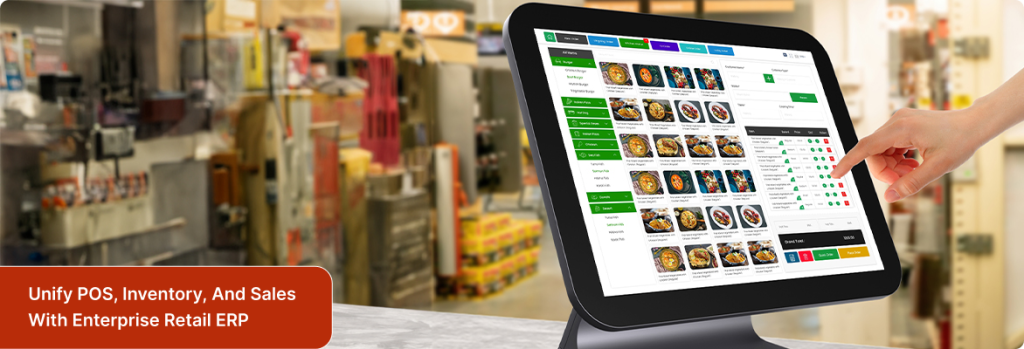
Unified Shipment Intelligence Model
Carrier APIs differ in authentication logic, rate limits, and payload formats. A normalized abstraction layer standardizes shipment data into a unified tracking model.
This enables:
– Automated delay alerts
– Coverage recalculations
– Real-time ETA adjustments
– Exception-based management
Such automation converts reactive firefighting into proactive supply planning.
Enterprise Inventory Forecasting and Predictive Control
Enterprise inventory forecasting within an Enterprise retail ERP must move beyond historical averages.
A modern forecasting engine includes:
- Sales velocity modeling
- Days of Coverage calculations
- Inbound shipment impact modeling
- Scenario toggles for seasonal adjustments
Keeping forecasting logic native to the ERP ensures:
– Immediate recalculations on sales updates
– No external sync delays
– Reduced data inconsistency risk
– Single source of operational truth
Because forecasting is embedded directly within the transaction layer, every confirmed sale, return, inbound shipment, or stock adjustment instantly influences coverage metrics and replenishment recommendations. There is no dependency on batch exports, third-party BI refresh cycles, or disconnected spreadsheets that introduce timing gaps.
Native forecasting also strengthens governance. Finance, operations, and procurement teams work from the same live dataset, eliminating cross-department reporting conflicts. When leadership reviews inventory exposure, cash flow impact, or reorder timelines, decisions are based on synchronized real-time data rather than lagging indicators.
Unified Financial Reporting Solutions Across Entities
Financial consolidation is where many Multi-Entity ERP Implementation projects fail.
A properly designed Enterprise retail ERP must support:
– Separate charts of accounts per entity
– Automated intercompany journal entries
– Consolidated P&L and balance sheets
– Stripe and PayPal webhook normalization
– Automated invoice matching
Unified financial reporting solutions reduce month-end closure time by up to 60 percent when exception-based reconciliation replaces manual matching.
Enterprise Retail ERP as a Strategic Control System
At Flexsin, we do not treat ERP implementation consulting as system configuration. We treat it as enterprise control architecture design.
Most ERP failures occur because organizations focus on modules instead of operational logic. Our approach starts with understanding how money moves, how goods move, how decisions are made, and where risk accumulates. Only then do we translate that understanding into system architecture.
Our framework includes:
Discovery Sprint – Process deconstructionWe dissect real transactions, not theoretical workflows. Purchase orders, returns, intercompany invoices, payment exceptions, and reporting dependencies are mapped at transaction level to eliminate blind spots before configuration begins.
Entity Mapping – Financial and operational topologyWe define how legal entities interact, where revenue is recognized, how COGS flows, and how consolidation should occur. This prevents structural accounting errors later in the lifecycle.
Cloud Blueprinting – ERP on AWS deployment modelWe design infrastructure around performance, isolation, backup resilience, and scalability. This ensures the Enterprise retail ERP can expand without re-architecture.
Automation Layering – Workflow engineeringManual checkpoints are replaced with rule-based automation. Intercompany triggers, shipment tracking alerts, payment reconciliation, and inventory updates are embedded directly into the operational fabric.
Data Trust Model – Governance and validationAccess controls, audit logs, validation rules, and multi-company filters are enforced to protect financial and operational integrity. Data reliability becomes a managed asset, not an assumption.
Continuous Optimization – Post-go-live refinementAfter deployment, we monitor usage patterns, exception trends, reporting gaps, and performance metrics. Improvements are iterative, measurable, and business-aligned.
Best Practices for Scalable Multi-Entity ERP
- Begin accounting architecture in Phase 1
- Build sandbox environments early
- Normalize APIs through abstraction layers
- Train users before go-live
- Maintain shared API knowledge bases
- Measure automation ROI in defined KPIs
Limitations and Realistic Trade-offs
Enterprise ERP transformation comes with practical constraints that leadership must acknowledge upfront. Custom modules, while powerful, increase upgrade governance effort and require disciplined version control to maintain compatibility with future releases. Multi-entity complexity demands strict role-based access management to prevent data leakage and reporting inconsistencies across legal units.
Forecasting accuracy is directly tied to the quality of historical data, meaning poor data hygiene can distort predictive outputs. Additionally, payment gateway integrations introduce edge cases such as partial captures, chargebacks, and currency variances that require ongoing exception handling and monitoring.
ERP modernization is not a zero-maintenance initiative. It requires operational maturity, structured governance, and continuous oversight to sustain long-term value.
Securing Scalable Growth with Enterprise Retail ERP
A well-architected Enterprise retail ERP is the difference between operational chaos and structured scale. For organizations navigating multi-entity DTC growth, disciplined architecture, cloud deployment, and automation-first thinking are non-negotiable.
If your enterprise is evaluating secure, scalable digital infrastructure and ERP consolidation strategy, contact Flexsin Technologies for advanced cyber threat intelligence solutions that protect your transformation journey from operational and security risk.
Frequently Asked Questions
1. What makes an Enterprise retail ERP different from standard ERP systems?An Enterprise retail ERP supports multi-entity governance, intercompany automation, and real-time consolidated reporting tailored for retail-driven operational complexity.
2. Why deploy ERP on AWS instead of shared SaaS hosting?ERP on AWS provides infrastructure isolation, customization flexibility, and cost predictability at scale. It also allows enterprises to maintain full control over performance tuning, security policies, and integration architecture without dependency on shared vendor environments.
3. How does Multi-Entity ERP Implementation reduce reconciliation time?It automates intercompany transactions and consolidates financial reporting into unified dashboards. By eliminating manual cross-entity matching and enforcing synchronized journal entries, it transforms month-end close into an exception-based review process rather than a manual reconciliation exercise.
4. Is Odoo enterprise implementation suitable for high-growth DTC brands?Yes. Odoo v18 offers modular scalability and multi-company support suited for expanding DTC ecosystems. Its flexible architecture allows new entities, warehouses, and sales channels to be added without disrupting existing operational workflows.
5. What role does enterprise inventory forecasting play in retail?It aligns procurement decisions with real-time sales velocity and inbound logistics visibility. This ensures working capital is deployed efficiently while reducing the risk of stockouts or excess inventory accumulation.
6. How does retail operations automation impact profitability?Automation reduces manual labor, minimizes shipping errors, and improves stock accuracy, directly impacting margins. Over time, these operational efficiencies compound into measurable improvements in cost control and customer satisfaction.
7. What is an ERP cost optimization strategy?It balances infrastructure control, licensing efficiency, and automation ROI to reduce long-term total cost of ownership. A well-designed strategy evaluates both technical and operational cost drivers to ensure sustainable scalability.
8. Can Unified financial reporting solutions support multiple currencies?Yes. Proper configuration supports multi-currency accounting and consolidated reporting across entities. This enables global enterprises to maintain statutory compliance while retaining centralized financial visibility.
9. How long does Retail ERP modernization typically take?Depending on complexity, phased implementation ranges from 6 to 12 months. Early discovery alignment and parallel accounting design can significantly accelerate stabilization and reduce post-go-live disruptions.
