

 +1.844.3539.746
 info@flexsin.com
How AI Development Tools Are Reshaping Modern Product Lifecycle Management?
 Munesh Singh
Let's talk
AI development tools are fundamentally redefining how enterprises manage Product lifecycle management across ideation, engineering, manufacturing, and post-launch optimization. By embedding intelligence into every stage, organizations accelerate decision cycles, reduce rework, and shift from reactive management to predictive, data-driven Product lifecycle management at scale.
Digital enterprises no longer treat product creation as a linear engineering task. It is an interconnected system of data, design, compliance, supply chain, and customer feedback. When AI development tools integrate with Product lifecycle management Software, the entire Product development lifecycle becomes adaptive, measurable, and continuously optimized.
From idea validation to intelligent product design and lifecycle analytics, AI is transforming how businesses conceive, build, test, launch, and refine products. The change is not incremental. It is structural, and digital product engineering services are at the center of this shift.
Rethinking Product Lifecycle Management in the AI Era
Product lifecycle management traditionally focused on documentation control, engineering changes, and version tracking. Today, Product lifecycle management must orchestrate dynamic data streams across Product design, manufacturing systems, IoT feedback loops, and service operations.
Modern Product lifecycle management Software is evolving into a cognitive backbone. It ingests structured and unstructured data. It surfaces design conflicts early. It predicts production bottlenecks. It identifies compliance risks before market exposure. AI development tools amplify this transformation by embedding intelligence directly into workflows rather than layering analytics afterward.
From Linear Stages to Intelligent Feedback Loops
The classic New product development process moved from concept to design to prototype to launch. Feedback was delayed. Decisions were sequential.
AI-enabled Product lifecycle management creates closed feedback loops. Simulation data informs early Product design. Customer telemetry informs next-generation design refinements, and manufacturing deviations automatically update engineering baselines. This way, product development process becomes iterative and continuously optimized.
Architecture of AI-Driven Product Lifecycle Management
An AI-enabled Product lifecycle management architecture typically includes:
– Unified product data backbone
– Digital twin environment
– Simulation engines
– Machine learning pipelines
– Cloud-native Product design software
– Integration APIs across ERP, MES, CRM
This layered architecture enables Smart product development by connecting strategy, engineering, and operations.
Core Components:
- Data layer – Centralized model-based definitions and digital thread connectivity
- Intelligence layer – AI development tools for prediction, optimization, and anomaly detection
- Experience layer – Collaborative Product design software environments
- Execution layer – Manufacturing and supply chain orchestration
When synchronized, these components transform static documentation into living intelligence.
AI Across the Product Development Lifecycle
1. Idea Validation and Market Fit
Traditionally, early product decisions relied heavily on intuition, historical assumptions, and limited survey data. Today, AI-driven analytics replaces guesswork with measurable insights.
Natural language processing models scan customer reviews, social conversations, support tickets, and industry forums to detect patterns in sentiment and unmet needs. Instead of manually reading thousands of comments, AI extracts themes such as recurring complaints, feature requests, pricing sensitivity, and brand perception.
Predictive analytics further strengthens validation by:
– Forecasting demand across segments
– Identifying emerging market gaps
– Analyzing competitor positioning in real time
– Estimating revenue potential based on historical behavior patterns
This shifts idea validation from “We think customers want this” to “Data confirms customers need this.” As a result, early-stage innovation becomes evidence-based, significantly reducing the risk of failed launches.
2. Intelligent Product Design
In traditional workflows, engineers begin with baseline concepts and iterate gradually. AI transforms this approach through generative design and constraint-based optimization.
AI algorithms evaluate thousands of possible configurations in minutes by factoring in:
- Structural performance requirements
- Weight and material constraints
- Cost targets
- Sustainability goals
- Regulatory compliance parameters
Instead of manually testing variations, engineers receive optimized design alternatives that balance strength, efficiency, and manufacturability. This dramatically reduces design cycles and accelerates innovation.
Additionally, AI integrates with modern product design software, enabling:
- Automated tolerance analysis
- Design-for-manufacturing recommendations
- Real-time feasibility validation
- Risk scoring for design complexity
The result is smarter product engineering decisions upfront, minimizing downstream corrections and engineering rework.
3. Simulation and Testing
Physical prototyping has traditionally been expensive and time-consuming. AI-powered predictive modeling reduces reliance on repeated physical builds. Through advanced simulation systems, digital twins replicate real-world behavior under various environmental and operational conditions. These virtual models simulate:
- Mechanical stress and fatigue
- Thermal performance and heat dissipation
- Vibration and impact scenarios
- Long-term wear and failure probabilities
- User interaction patterns
Machine learning algorithms continuously improve simulation accuracy by learning from historical performance data. Testing cycles that once required weeks can now be completed in hours. AI also identifies anomaly patterns that human testers might overlook. This leads to earlier detection of potential product weaknesses, strengthening reliability before launch.
4. Manufacturing Optimization
AI continues delivering value once a design enters production. In smart manufacturing environments, AI monitors machines, sensors, and supply chain variables in real time.
Advanced analytics systems detect micro-deviations in:
- Temperature fluctuations
- Pressure inconsistencies
- Assembly alignment tolerances
- Material quality variations
Instead of reacting to defects after they occur, AI predicts issues before they escalate. This enables proactive maintenance, prevents production stoppages, and significantly reduces scrap rates.
Key Benefits:
- Higher yield percentages
- Lower rework costs
- Shorter cycle times
- Improved overall equipment effectiveness (OEE)
AI also enhances supply chain forecasting by analyzing demand signals, raw material availability, and logistics performance. Production planning becomes adaptive rather than static.
5. Post-Launch Intelligence
The lifecycle does not end at product release. AI extends visibility into the operational phase through connected product ecosystems. Smart devices, IoT systems, and embedded sensors continuously collect performance data. This real-world intelligence feeds back into Product lifecycle management systems, creating a closed feedback loop.
Post-launch AI Capabilities:
- Usage pattern analytics
- Predictive maintenance alerts
- Failure trend detection
- Customer behavior segmentation
- Feature adoption tracking
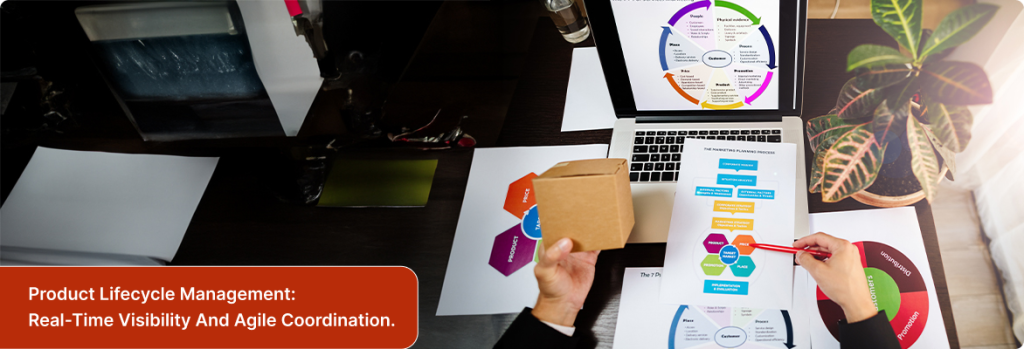
The Strategic Impact:
AI does not simply automate tasks, it fundamentally redefines how decisions are made across the product lifecycle management. By embedding intelligence into every stage, from idea generation and concept validation to manufacturing and post-launch optimization, artificial intelligence enables organizations to operate with greater speed, precision, and confidence. It accelerates innovation cycles by reducing manual bottlenecks, lowers operational risk through predictive insights, and strengthens data-driven decision-making across cross-functional teams.
At the same time, AI enhances product reliability by identifying potential failures earlier and supports improved sustainability metrics through optimized material usage and resource efficiency. In essence, AI transforms the Product development lifecycle into a smarter, more resilient, and strategically aligned growth engine.
In modern product ecosystems, speed, precision, and adaptability determine market leadership. AI enables companies to deliver all three – at scale.oftware. Service insights guide incremental updates and future New product development initiatives.
Comparison – Traditional vs AI-Enabled Product Lifecycle Management
| Dimension | Traditional PLM | AI-Enabled Product lifecycle management |
|---|---|---|
| Data Usage | Historical records | Real-time predictive analytics |
| Design Iterations | Manual revisions | Algorithm-driven design optimization |
| Risk Detection | Post-failure | Pre-failure predictive alerts |
| Decision Speed | Sequential approvals | Parallel intelligent workflows |
| Feedback Loop | Delayed | Continuous digital thread |
Best Practices for Implementing AI in Product Lifecycle Management
- Start with data governance maturity as AI cannot compensate for fragmented data
- Integrate Product lifecycle management Software with ERP and IoT systems early
- Use modular AI development tools to scale incrementally
- Align engineering, IT, and operations leadership
- Establish measurable KPIs – time-to-market, defect rate, change cycle time
AI adoption across the product development lifecycle comes with practical limitations and implementation trade-offs that organizations must carefully evaluate. First, AI models are only as effective as the data they are trained on, meaning high-quality, structured historical data is essential. Without clean, consistent datasets, predictive accuracy declines and decision confidence weakens. Second, many organizations still operate on legacy Product design software that was not built for advanced AI integration, limiting interoperability and slowing digital transformation efforts.
In addition, talent gaps in data science, machine learning, and AI governance can delay deployment, as successful implementation requires cross-functional expertise. The initial financial investment – covering infrastructure upgrades, software integration, and workforce training – can also be substantial. However, despite these challenges, organizations that strategically modernize their product development services using structured AI frameworks, clear governance models, and phased implementation roadmaps often realize measurable returns on investment within 18 to 24 months.
Intelligent Product Lifecycle Acceleration Framework
At Flexsin, we view Product lifecycle management transformation through a five-stage framework: This structured approach aligns strategy, data, processes, and technology to create a scalable AI-enabled ecosystem. Each stage is designed to accelerate innovation cycles, enhance cross-functional collaboration, and deliver measurable business outcomes across the entire product lifecycle, including:
- Digital foundation mapping
- AI readiness assessment
- Modular AI integration within product lifecycle management software
- Cross-functional operating model redesign
- Continuous performance optimization
We prioritize measurable outcomes. Reduced engineering cycle time. Lower warranty claims. Faster New product development process execution. Our enterprise clients treat AI development tools not as experimental features but as embedded operational capabilities.
The Strategic Future of Product Lifecycle Management
As products become increasingly software-defined, sensor-enabled, and connected through digital ecosystems, Product lifecycle management transforms from a static documentation repository into a dynamic, real-time intelligence network. Instead of merely storing design files, change logs, and compliance records, modern Product lifecycle management platforms continuously ingest data from engineering systems, manufacturing lines, supply chains, and even products in the field.
This interconnected flow of information enables faster feedback loops, proactive decision-making, and synchronized collaboration across departments. Intelligent product design powered by AI-driven generative tools allows teams to optimize performance, cost, and sustainability simultaneously. Digital twins provide virtual replicas that simulate real-world behavior, reducing physical prototyping and accelerating validation cycles.
Predictive analytics anticipates failures, demand shifts, and operational bottlenecks before they occur. Together, these capabilities redefine competitive advantage, not through incremental improvements, but through speed, precision, and adaptability at scale. Enterprises seeking to modernize Product lifecycle management must treat AI as a strategic operating layer, not an add-on. The competitive frontier now lies in predictive intelligence across the entire Product development lifecycle.
For organizations looking beyond product intelligence toward holistic digital resilience, Flexsin also delivers advanced cyber threat intelligence solutions that protect critical engineering, manufacturing, and data ecosystems. Contact Flexsin Technologies to secure innovation at scale.

Frequently Asked Questions
1. What is Product lifecycle management in the context of AI?Product lifecycle management with AI integrates predictive analytics, simulation, and real-time feedback into the entire Product development lifecycle, enabling faster and more informed decisions. It transforms PLM from a documentation system into a continuous intelligence platform that connects design, manufacturing, and field performance data.
2. How do AI development tools improve Product design?They generate optimized configurations, reduce manual iterations, and simulate performance outcomes before physical prototyping. This shortens design cycles while improving accuracy, sustainability, and cost efficiency from the earliest stages.
3. Is AI-based Product lifecycle management suitable for small businesses?Yes, cloud-based Product lifecycle management Software allows scalable adoption without heavy infrastructure investment. Modular deployment options also enable small and mid-sized firms to start with targeted use cases and expand gradually.
4. What industries benefit most from Smart product development?Manufacturing, automotive, aerospace, healthcare devices, and consumer electronics see significant measurable gains. Any industry managing complex engineering processes or regulatory requirements can leverage AI-driven PLM for competitive advantage.
5. How does AI reduce time-to-market?By automating testing simulations, predicting risks, and streamlining collaboration within the Product development process. It also minimizes costly redesigns by identifying potential issues earlier in the lifecycle.
6. What is the role of a Software product development company in PLM transformation?Such companies integrate AI tools, customize Product design software, and ensure seamless enterprise system interoperability. They also define governance frameworks and implementation roadmaps to maximize long-term ROI.
7. Does AI replace engineers in the New product development process?No. AI augments engineers by accelerating analysis and enabling data-driven decisions. Human expertise remains essential for strategic thinking, creativity, and contextual judgment.
8. What are common risks in AI-enabled Product lifecycle management?Poor data quality, integration complexity, and unclear ROI metrics can hinder outcomes. Strong data governance and phased deployment strategies help mitigate these risks effectively.
9. How long does AI-driven PLM implementation take?Enterprise deployments typically range from 6 to 18 months depending on scope and system maturity. Pilot projects and proof-of-concept initiatives can often deliver early value within the first few months.
