

 +1.844.3539.746
 info@flexsin.com
DevSecOps for automating AI risk management in digital banking services
 Munesh Singh
Let's talk
AI risk management in digital banking services requires continuous control across code, data, models, and infrastructure. DevSecOps embeds security, regulatory compliance automation, and financial risk management into delivery pipelines, helping banks scale AI safely while reducing fraud risk and regulatory exposure.
Digital banking services now operate in rapid release cycles driven by APIs and AI models, reshaping risk management. With rising customer expectations, regulatory scrutiny, and evolving AI risks, DevSecOps solutions become the execution engine for scalable AI risk management, typically implemented with guidance from an IT services company.
What Is DevSecOps in the Context of AI Risk Management?
DevSecOps consulting becomes critical when AI systems directly influence financial decisions, customer onboarding, and transaction monitoring. In this environment, AI risk management must be embedded into engineering workflows rather than handled as a downstream compliance activity. The integration of security and risk controls into delivery pipelines ensures digital banking services remain resilient.
What is DevSecOps?
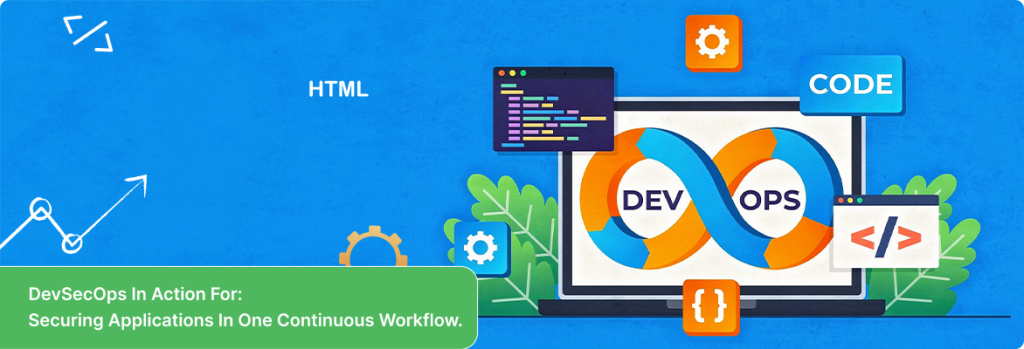
What is DevSecOps in modern banking environments? It is the integration of security, compliance, and risk management controls directly into the DevOps lifecycle. Security shifts left. Risk monitoring shifts continuous. Controls become programmable assets instead of static documents.
In digital banking services, DevSecOps services expand beyond vulnerability scanning. It governs model training pipelines, API security, fraud detection rules, identity management, and audit traceability. A DevOps engineer no longer deploys code alone. They deploy controls.
Why AI Changes the Risk Equation?
AI risk management introduces new categories of exposure. Model bias, data drift, adversarial attacks, explainability gaps, and automated decision risk are not addressed by conventional risk management frameworks. They require integrated telemetry across data sources, model repositories, and runtime behavior. A mature DevSecOps practice embeds AI risk controls into build pipelines, model validation workflows, and runtime monitoring layers.
Enterprise Architecture for AI Risk Management Automation
DevOps solutions provide layered architecture that maps risk management objectives to technical controls. This architecture by custom fintech solutions provider must connect development pipelines, security controls, data platforms, and compliance reporting into a unified operating model. Without architectural alignment, AI risk management remains fragmented, reactive, and difficult to scale across digital banking services.
Secure Development and Model Governance
Source repositories must enforce secure coding standards, secrets management, and code reviews. Model repositories must track lineage, training data provenance, hyperparameters, and approval gates. DevSecOps tools automate these checks before promotion to production.
AI Risk Management and Regulatory Compliance Automation
Regulatory compliance automation ensures every deployment is traceable. Policy-as-code frameworks evaluate infrastructure against regulatory requirements. Every environment change is logged. Every configuration deviation triggers alerts. This architecture by DevOps company connects financial risk management teams with technology execution layers. Instead of retrospective audits, banks gain real-time compliance dashboards.
Runtime Monitoring and Fraud Prevention Solutions
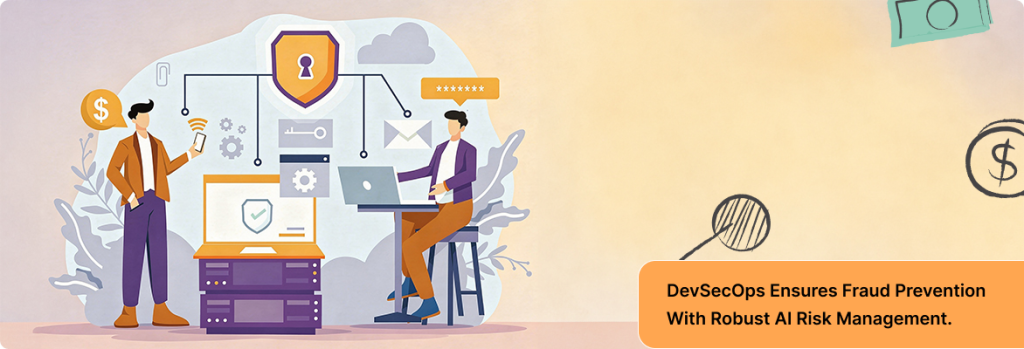
Fraud prevention solutions increasingly rely on AI models operating in real time. DevSecOps pipelines must integrate anomaly detection, transaction risk scoring, and behavioral analytics telemetry into monitoring systems. If a model’s accuracy drops below threshold or bias metrics deviate, automated rollback mechanisms activate. That is AI risk management embedded operationally.
AI Risk Management Framework for Digital Banking Services
The framework ensures AI risk management is embedded across data, models, infrastructure, and governance layers rather than treated as an isolated compliance function. It enables digital banking services to scale innovation while maintaining structured financial risk management and regulatory compliance automation controls.
A structured risk management framework for AI-enabled banking includes five pillars:
- Data integrity validation
- Model validation and explainability controls
- Infrastructure security hardening
- Continuous regulatory compliance automation
- Incident response orchestration
Each pillar maps to measurable KPIs. For example, mean time to remediate vulnerabilities under 48 hours. Model drift detection under 15 minutes. Audit evidence generation in real time. DevSecOps best practices ensure these controls are repeatable and scalable. Without automation, risk management becomes reactive and fragmented.
Role of the DevOps Engineer in AI Risk Management
The DevOps engineer evolves into a control engineer. Responsibilities expand beyond deployment automation to include:
– Security pipeline orchestration
– Policy-as-code implementation
– Container and API hardening
– AI model validation integration
– Observability configuration
This transformation by DevOps consulting services reduces the disconnect between technology teams and financial risk management stakeholders. Risk becomes measurable in system logs, not PowerPoint slides.
DevSecOps Tools and Technology Stack
When integrated correctly, the DevSecOps technology stack transforms fragmented risk management activities into a unified, automated control system for digital banking services. The selection must align with the bank’s risk management framework. Tool sprawl without governance increases complexity rather than reducing risk.
DevSecOps tools typically include:
- Static and dynamic application security testing
- Infrastructure-as-code scanners
- Container security platforms
- Secrets management systems
- Model monitoring platforms
- Compliance automation dashboards
These tools operate across the software lifecycle, from code commit to production runtime, creating continuous visibility into security and AI risk management controls. Traditional risk management relies heavily on post-deployment review cycles, manual documentation, and periodic validation of models. Fraud detection often depends on rule-based updates, while regulatory reporting typically follows quarterly cycles.
In contrast, DevSecOps-driven AI risk management embeds controls before and during continuous deployment, generates automated trace logs for audit evidence, enables real-time telemetry for model monitoring, supports adaptive AI pipelines for fraud detection, and ensures continuous compliance automation.
DevSecOps Best Practices for AI Risk Management
DevSecOps best practices ensure AI risk management is proactive rather than reactive across digital banking services. When consistently applied, these practices create measurable alignment between engineering velocity, financial risk management objectives, and regulatory compliance automation requirements.
Best Practices:
- Shift security and model validation left
- Automate policy enforcement
- Implement zero trust access models
- Standardize logging and observability
- Quantify risk exposure in financial terms
- Align KPIs between engineering and compliance
DevSecOps best practices are not tooling exercises. They are operating model transformations. They redefine how AI risk management is measured, enforced, and reported across digital banking services. When embedded correctly by custom DevOps solutions provider, they create a resilient foundation for scalable innovation without compromising financial risk management discipline.
Operational Challenges and Adoption Barriers
Automation requires cultural change. Banks must retrain teams. Legacy systems may resist integration. Over-automation without governance can create alert fatigue. Investment is required in upskilling DevOps engineers and aligning risk management teams with engineering cycles. However, the alternative is escalating operational risk and regulatory exposure.
The Embedded Risk Intelligence Model
At Flexsin, we implement an Embedded Risk Intelligence Model. It connects AI risk management objectives with DevSecOps pipelines through three layers:
- Control Codification Layer – translating regulatory requirements into executable policies
- Intelligent Monitoring Layer – continuous AI model telemetry and fraud analytics
- Governance Integration Layer – unified dashboards for board-level reporting
This approach by Flexsin’s DevOps consulting services ensures digital banking services scale without compromising financial risk management integrity. It also creates measurable alignment between engineering velocity and regulatory accountability. As a result, banks gain real-time visibility into risk exposure while accelerating secure AI innovation.
Frequently Asked Questions
1. How does DevSecOps improve AI risk management in banks?DevSecOps soutions embed automated controls into development pipelines, ensuring vulnerabilities, compliance violations. It integrates static analysis, infrastructure scanning, and runtime monitoring into a single workflow. This continuous validation model reduces human error, shortens remediation cycles, and strengthens AI risk management across digital banking services.
2. What is DevSecOps compared to DevOps?DevSecOps services ntegrate security and risk management into DevOps processes rather than treating them as separate review stages. While DevOps focuses on speed and reliability of software delivery, DevSecOps adds structured governance, regulatory compliance automation, and financial risk management checkpoints. The result is balanced velocity where innovation does not compromise control.
3. What is Ai risk management in digital banking services?AI systems influence credit decisions, fraud detection, transaction approvals, and automated financial advice. Errors or bias in these systems can trigger regulatory penalties, reputational damage, and direct financial loss. AI risk management ensures transparency, explainability, and accountability in high-stakes banking environments.
4. What role does a DevOps engineer play in risk management?A DevOps engineer implements automated security checks, compliance validation, and monitoring pipelines that reduce operational exposure. They configure policy-as-code, manage secure CI/CD workflows, and integrate DevSecOps tools into release cycles. Their role bridges engineering execution with enterprise risk management objectives.
5. Can DevSecOps support regulatory compliance automation?Yes. Policy-as-code frameworks, automated evidence collection, and continuous logging systems provide real-time audit trails aligned with regulatory standards. This reduces manual documentation effort and ensures every deployment is traceable. Regulatory compliance automation becomes a built-in system capability rather than a reactive audit exercise.
6. How do fraud prevention solutions integrate with DevSecOps?Fraud prevention solutions powered by AI are embedded into secure pipelines where models are tested for bias, accuracy, and drift before production release. Continuous telemetry monitors real-time performance, triggering alerts if anomalies occur. This integration ensures fraud detection remains adaptive and aligned with risk management frameworks.
7. What are common DevSecOps tools used in banking?Common DevSecOps tools include static and dynamic application security testing platforms, container security solutions, infrastructure-as-code scanners, secrets management systems, and AI model monitoring tools. These technologies work together to automate risk management across application, infrastructure, and data layers.
8. Does DevSecOps replace traditional risk management?DevSecOps development does not replace traditional risk management. It operationalizes it by embedding controls into technology workflows and automating enforcement. Governance teams still define policies, but enforcement becomes continuous and system-driven.
9. What are the biggest implementation challenges?Cultural resistance, legacy system constraints, and skill gaps are common barriers. Many institutions struggle to align engineering speed with regulatory oversight expectations. Successful adoption requires executive sponsorship, clear KPIs, and structured DevSecOps best practices.
10. How can banks measure ROI from AI risk management automation?Banks can measure ROI through reduced fraud losses, shorter vulnerability remediation time, improved deployment velocity, and lower compliance preparation costs. Additional indicators include fewer audit findings, higher model stability, and measurable reduction in operational risk exposure.
AI risk management is no longer optional in digital banking services. It must be automated, measurable, and embedded across development pipelines. Organizations that integrate DevSecOps into financial risk management strategies will scale AI innovation securely while meeting regulatory expectations.
Flexsin helps banks operationalize AI risk management through integrated DevSecOps architectures, regulatory compliance automation, and cyber threat intelligence solutions designed for modern digital banking services. Contact Flexsin Technologies to build resilient, audit-ready, and future-proof banking platforms.
