

 +1.844.3539.746
 info@flexsin.com
How AI social media trends are redefining the creator power in 2026
 Chiranjit Paul
Let's talk
Social platforms now function as discovery engines where audiences search, compare, and decide inside feeds. Social media trends 2026 are being reshaped by AI systems that control visibility, relevance, and commercial reach.
Creator power is no longer driven by follower count alone but by social search behavior, AI content interpretation, and alignment with user intent content across platforms. AI in social media determines which creators surface, which formats scale, and which narratives convert, making this shift structural rather than cosmetic.
The structural shift behind modern social media trends
Social media trends are no longer driven by viral creativity or platform novelty. They are shaped by how artificial intelligence systems interpret content signals, map them to user intent, and decide what deserves visibility at scale. Virality is now a secondary effect.
Modern platforms operate as intelligent discovery engines, evaluating posts on engagement, relevance, consistency, and predictive value. Creators who understand this architecture gain compounding visibility, while those chasing surface-level trends see diminishing returns.
From broadcast feeds to intent-driven ecosystems
Platforms have shifted from broadcast-style feeds to intent-driven ecosystems. Users now treat social networks as search environments, looking for answers, comparisons, tutorials, opinions, and real experiences within platforms. This shift changes what performs. Content structured around questions, problems, and outcomes aligns with modern discovery behavior.
Social media trends in marketing now reward clarity, structure, and usefulness, with entertainment supporting comprehension and intent. Creators who frame content around decision points-what to choose, how to act, why it matters-are favored by discovery systems, as purposeful search now drives visibility.
AI as the invisible editor
AI in social media functions as an always-on editorial layer. It continuously evaluates content based on engagement velocity, semantic relevance, watch behavior, and inferred trust signals. This evaluation happens long after a post is published, not just at launch.
Because of this, loosely themed or inconsistent posting no longer scales. AI social search tools reward precision. User intent content that clearly matches a defined intent category is easier to classify, easier to recommend, and more likely to resurface across multiple contexts. Precision, not frequency, becomes the growth lever.
How AI in social media impacting creator reach and influence
Creator power in 2026 is no longer about audience ownership or follower counts. It is about being selected by AI systems at the precise moment a user expresses intent. Visibility is situational, not permanent.
AI social media & marketing systems assess creators across multiple dimensions: topical authority, consistency, audience response patterns, and historical performance in similar discovery contexts. This means influence is earned repeatedly, not inherited from past success.
How AI Systems Decide Which Creators Get Seen?
- AI prioritizes contextual relevance over creator size, surfacing content that best matches a user’s immediate intent rather than the creator’s follower base.
- Creator authority is now topic-specific, not platform-wide. A creator may rank highly in one discovery context and remain invisible in others.
- Consistent signal quality-watch time, saves, rewatches, and completion rates-matters more than one-off viral spikes.
- Historical performance is evaluated per intent pattern, meaning creators must repeatedly prove usefulness in similar queries or scenarios.
- Influence has shifted from being an asset you own to a state you earn moment by moment through relevance, clarity, and trust signals.
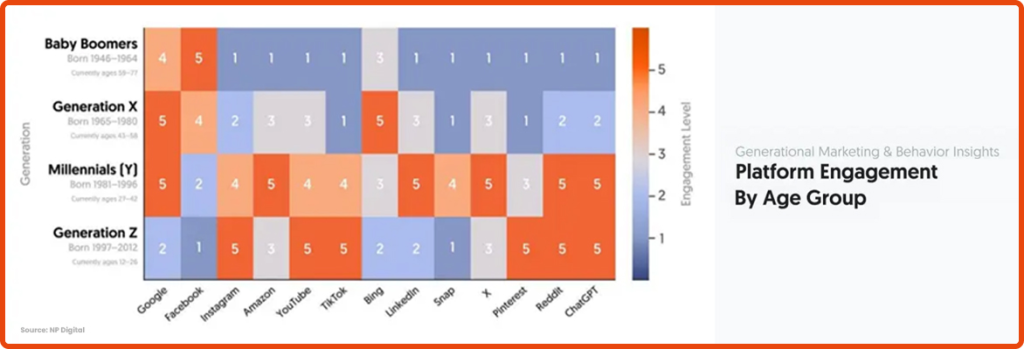
AI systems factor these behavioral patterns into discovery decisions, elevating creators whose content aligns with the dominant engagement signals of a specific audience-platform combination. The image reinforces the idea that creator power is contextual and situational: influence emerges where content relevance, user behavior, and platform dynamics intersect, not where legacy audience size happens to exist.
Authority beats popularity in social media trends
Creators with smaller, tightly focused audiences often outperform larger creators with mixed or inconsistent themes. AI social media optimization companies prioritize topical authority because it increases the likelihood of user satisfaction. This marks a defining shift in social media marketing trends.
A creator known for one domain is more predictable, easier to recommend, and more valuable to intent-driven discovery systems. Authority compounds over time. Each high-quality interaction strengthens the creator’s relevance profile, making future content more likely to surface.
Trust becomes a measurable signal in social media trends
Trust is no longer abstract. AI systems infer trust through behavioral indicators such as completion rates, saves, meaningful comments, and repeat exposure patterns. These signals suggest that content helped someone think, decide, or act.
Creators who educate, explain, and guide decision-making consistently accumulate algorithmic leverage. This is why agency social media marketing strategies increasingly prioritize expert-led and insight-driven content over purely promotional messaging. Trust converts attention into sustained visibility.
Social search optimization as the new growth engine
Social search optimization (SEO) now sits at the center of modern social media trends. It blends keyword intent, semantic clarity, and content structure designed for AI interpretation within platforms. Unlike traditional SEO, social search is contextual and adaptive. Rankings shift based on real-time behavior, audience signals, and emerging patterns. Discovery is dynamic, not static.
Designing content for discovery, not distribution
Creators and brands must plan content around how users actively search inside platforms. Queries are conversational, situational, and problem-focused. People ask “how,” “which,” and “why”-often implicitly through their viewing behavior.
Social media and marketing strategies that ignore search behavior lose reach, even when production quality is high. Discoverability in AI social media trends 2026 depends on relevance, not polish alone. Content designed for discovery anticipates questions before they are asked and delivers answers with minimal friction.
Structuring posts for AI extraction
Well-structured user intent content is easier for AI to interpret and match multiple discovery paths. This approach by a social media marketing (SMM) company supports consistent resurfacing rather than one-time exposure.
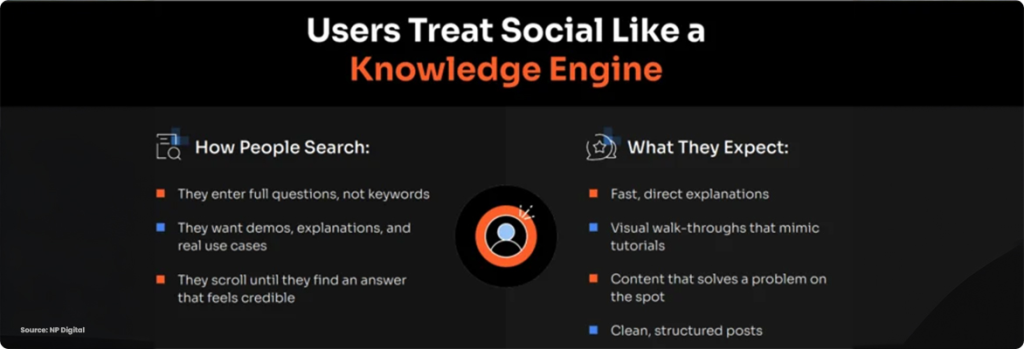
The attached visual reinforces how users treat social platforms as knowledge engines. It highlights the gap between how people search-through questions, demos, and real-use scenarios, and what they expect: fast clarity, visual walkthroughs, and problem-solving content, supporting social search optimization over high-polish but unfocused posts.
AI social media tools powering creator scale
AI social media tools have moved from experimentation to infrastructure. They now form the operational backbone of scalable creator and brand workflows. These social search tools support content planning, performance forecasting, audience segmentation, and adaptive publishing. Scale is no longer limited by manual effort.
Predictive content modeling as the driver of social media trends
Advanced tools can simulate likely performance before content goes live. By analyzing historical data and current platform signals, they guide creative direction with greater confidence. This reduces wasted experimentation and allows creators to focus energy on ideas on social media trends 2026, with the highest strategic potential.
Automated optimization loops
AI social search tools now adjust posting times, formats, and distribution logic based on real-time feedback. Optimization happens continuously, not retrospectively. For a social media marketing agency, this enables higher output without sacrificing quality. Systems handle adaptation while humans focus on strategy and creativity.
Social media trends in marketing for brands and agencies
- Brands no longer control narratives independently
- Creator ecosystems now shape perception, trust, and conversion at scale
Modern social media marketing trends prioritize:
- Collaboration over one-way broadcasting
- Co-creation instead of brand-only messaging
- Distributed authority rather than centralized control
The rise of creator-led funnels
Creators influence every stage of the customer journey:
- Awareness
- Consideration
- Decision-making
AI systems detect and amplify creators who consistently guide users across funnel stages
Agencies must:
- Assign creators to defined funnel roles
- Move away from treating influence as generic reach
- Performance measurement beyond vanity metrics
- Likes and reach are no longer reliable indicators of performance
Advanced measurement frameworks track:
- Assisted conversions
- Search visibility lift within platforms
- Intent match rates
Agency-led social media marketing differentiates itself by:
- Focusing on business outcomes
- Measuring impact beyond surface-level attention
Moving forward with intelligent social media strategy
At Flexsin, AI in social media is viewed as an enterprise system, not a creative shortcut. Like any intelligent platform, it requires governance, architecture, and structured feedback loops.
Organizations that treat social media & marketing trends as isolated tactics will fall behind. Those that integrate AI, social search, and creator workflows into unified systems build durable advantage.
To explore how intelligent platforms, data systems, and AI-led governance can strengthen digital resilience and scalable growth, contact Flexsin Technologies. Our teams help enterprises design insight-driven ecosystems that scale with confidence.
Frequently Asked Questions
1. Why are social media trends in 2026 so AI-dependent?Social media platforms operate at a scale that makes human curation impossible. Billions of posts, videos, and interactions are created daily, requiring automated systems to determine relevance, safety, and distribution in real time. Rather than ranking content based on popularity alone, AI evaluates semantic meaning, behavioral feedback, and contextual relevance.
2. How does social search differ from traditional search?Traditional search relies on relatively static ranking factors such as keywords, backlinks, and page authority. Results change slowly and are largely independent of individual behavior. Social search is dynamic and contextual. Results are influenced by engagement patterns, watch behavior, saves, and repeat interactions.
3. What role do creators play in social media trends?Creators function as trusted interpreters between brands and audiences. Rather than delivering polished brand messages, they translate products, services, and ideas into relatable, experience-based guidance. AI systems favor creators who consistently align content with user intent.
4. Are AI social media tools replacing human creativity?AI social media tools do not replace creativity. They enhance it. These tools assist with planning, optimization, and performance analysis, allowing creators and teams to make more informed decisions. The most effective workflows by social media optimization (SMO) companies combine human intuition with machine-driven optimization.
5. How should a social media marketing agency adapt to social media trends 2026?Agencies must move beyond content calendars and posting schedules. Success now requires integrating creator strategy, AI tooling, and social search optimization into a single operating model. AI social media agencies that adopt this systems-level approach deliver more predictable outcomes than those relying on manual execution alone.
6. What metrics matter most in AI-driven social media trends?Vanity metrics such as likes and raw reach provide limited insight into real performance. AI-driven platforms prioritize signals that indicate usefulness and intent alignment. Key metrics include intent match rate, content retention and completion, assisted conversions, saves, and improvements in search visibility within platforms.
7. Is AI in social media a risk or an opportunity for brands?AI in social media is both a risk and an opportunity. Without a clear strategy, brands may experience reduced visibility as algorithms deprioritize unfocused or inconsistent content. Brands that invest in authority, trust, and intent-aligned content benefit from compounding visibility over time.
