

 +1.844.3539.746
 info@flexsin.com
The Future of Field Service: Agentic Analytics Strategy to Drive Productivity at Scale
 Munesh Singh
Let's talk
Agentic analytics is redefining how field service organizations drive productivity by shifting analytics from passive reporting to active, decision-oriented intelligence. By embedding AI-driven, conversational analytics into field service operations, organizations can move faster from insight to action, optimize service execution, and scale productivity across increasingly complex service environments.
Field service has become one of the most operationally complex functions in modern enterprises. Dispersed workforces, rising customer expectations, tighter service-level commitments, and cost pressures have made traditional reporting and dashboard-based analytics insufficient. Service leaders need analytics that not only explain what happened but also guide what to do next.
This is where agentic analytics changes the equation. Instead of relying on static metrics reviewed after the fact, agentic analytics operates as an intelligent layer within field service management, continuously analyzing data, surfacing insights, and supporting decisions in real time. The result is a more adaptive, resilient, and productive service organization built for scale with the support of digital product engineering.
Understanding Agentic Analytics in Modern Field Service Operations
Agentic analytics represents a fundamental evolution in how analytics functions within field service operations. Instead of acting as a downstream reporting tool that summarizes performance after work is completed, it operates as an active participant in service execution. By continuously analyzing live operational data and responding to changing conditions, agentic analytics helps guide decisions as they happen, influencing scheduling, prioritization, and resource allocation in real time.
What Makes Agentic Analytics Different?
Traditional analytics focuses on historical data, predefined dashboards, and manual interpretation. Agentic analytics combines AI-driven reasoning, contextual awareness, and conversational analytics to deliver insights that are timely, relevant, and actionable. In field service environments, this means analytics that can respond to operational questions, highlight emerging risks, and recommend next actions without waiting for scheduled reviews.
Why Field Service Requires an Agentic Approach?
Field service operations are dynamic by nature. Technician availability changes, job complexity varies, customer priorities shift, and external factors disrupt schedules. Agentic analytics for field service is designed to operate in this constantly changing environment by continuously analyzing data streams and supporting decisions as conditions evolve.
Agentic Analytics for Field Service Management
As field service organizations expand in size and complexity, managing productivity becomes exponentially more challenging. Growth introduces more technicians, broader geographic coverage, diverse service offerings, and higher volumes of service requests, all of which increase operational variability. Traditional analytics approaches often struggle to keep pace, relying on manual interpretation and delayed reporting that cannot support decisions at scale.
From Fragmented Reporting to Unified Service Intelligence
Many field service organizations struggle with fragmented data spread across scheduling systems, asset records, customer platforms, and performance reports. Agentic analytics unifies these inputs, creating a single operational view that supports service operations management and field service optimization.
Conversational Analytics in Daily Service Execution
Conversational analytics allows service leaders and managers to interact with data using natural language. Instead of navigating complex dashboards, teams can ask questions about service backlogs, technician performance, or customer impact and receive contextual responses that support faster action.
Architecture and Capabilities Behind Agentic Analytics
Agentic analytics relies on an architecture purpose-built to process data continuously and convert insights into actionable operational guidance. Instead of operating on static data snapshots, this architecture by Agentic AI service company ingests real-time data from across field service systems, analyzes changing conditions as they occur, and delivers context-aware intelligence that supports timely decision-making.
Core Components of an Agentic Analytics Framework
Key components include real-time data ingestion, AI-driven reasoning engines, conversational interfaces, and decision-support logic. Together, these elements enable analytics to move beyond observation and actively support service execution.
Integration with Field Service Management Platforms
To deliver value at scale, agentic analytics integrates directly into field service management systems. This ensures insights are embedded within existing workflows rather than isolated in separate analytics tools.
Key Field Service Metrics Through an Agentic Lens
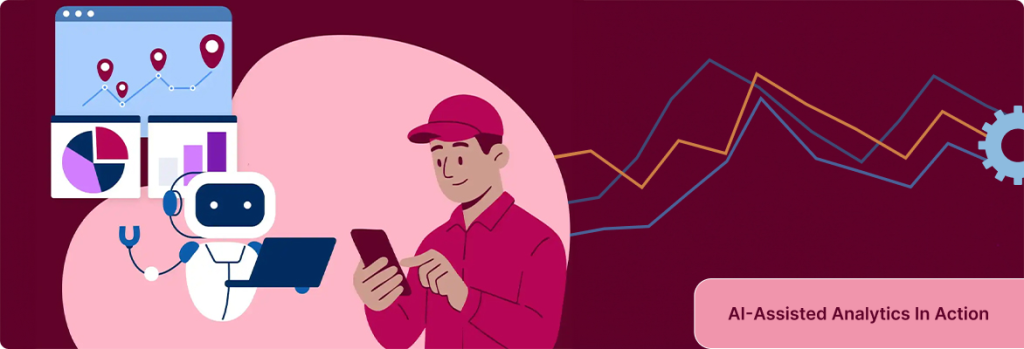
Key field service metrics remain critical to understanding service performance, but agentic analytics fundamentally changes how those metrics are interpreted and applied. Rather than serving as static indicators reviewed after the fact, metrics become dynamic signals that continuously inform operational decisions. Agentic analytics evaluates metrics in real time, placing them in context with workforce availability, service demand, asset conditions, and customer impact.
Moving Beyond Static KPIs
Metrics such as first-time fix rate, technician utilization, response time, and customer satisfaction have long been used to assess field service performance. However, when these metrics are reviewed in isolation or on a periodic basis, they provide limited guidance for day-to-day decision-making. Agentic analytics changes this approach by continuously evaluating key field service metrics in context, considering factors such as workload fluctuations, resource availability, asset complexity, and customer impact.
Turning Metrics into Action
Rather than stopping at performance measurement, agentic analytics translates metrics into actionable guidance. It highlights where intervention is required, prioritizes issues based on business impact, and suggests which actions are most likely to improve outcomes. By linking metrics to operational decisions, agentic AI development company enables teams to move from reactive reporting to proactive execution, ensuring that performance insights directly influence scheduling, resource allocation, and service optimization efforts across the organization.
Agentic analytics supports a structured use case ladder in field service environments, enabling organizations to scale value as maturity increases. At a primary level, organizations use agentic analytics to gain real-time visibility into field service operations and support day-to-day decision-making for dispatch, scheduling, and service prioritization, helping teams respond faster to operational changes.
At a secondary level, agentic analytics enables improvements in technician productivity, workforce allocation, and service efficiency by identifying bottlenecks and performance gaps across teams. As adoption deepens, niche use cases emerge in scenarios such as predictive service interventions, complex asset maintenance environments, and service operations with highly variable demand patterns, where real-time intelligence becomes critical.
At an industry-specific level, sectors such as utilities, telecommunications, manufacturing, and healthcare rely on agentic analytics to balance service reliability, regulatory compliance, and cost control, while continuing to meet customer expectations and service-level commitments at scale.
Why Agentic Analytics Is Becoming a Strategic Imperative?
From Flexsin Technologies’ perspective, agentic analytics is not just a technology upgrade. It represents a strategic shift in how service organizations operate. As field service environments become more complex, productivity gains increasingly depend on intelligent systems that support decisions in real time. Our AI development services allow organizations to embed intelligence directly into service operations, creating a foundation for scalable, AI-first service strategies.
Agentic Analytics Compared to Traditional Field Service Analytics
| Aspect | Traditional Analytics | Agentic Analytics |
|---|---|---|
| Role | Reporting and visibility | Decision support and guidance |
| Timing | Retrospective | Real-time |
| Interaction | Dashboard driven | Conversational analytics |
| Scalability | Limited by manual interpretation | Designed for scale |
| Impact | Insight focused | Action focused |
Best Practices for Implementing Agentic Analytics
Successful adoption starts with aligning analytics goals to service outcomes, not just metrics. Organizations should integrate agentic analytics into operational workflows, ensure data quality across systems, and train teams to trust and act on AI-driven insights. Continuous refinement is essential as service environments evolve.
Limitations and Considerations
Agentic analytics does not replace human judgment. Service leaders must define decision boundaries, governance models, and accountability structures. Organizations must also invest in change management to ensure teams adopt new ways of working supported by AI-driven intelligence.
Frequently Asked Questions
1. What is agentic analytics in field service?Agentic analytics in field service refers to AI-driven analytics that goes beyond traditional reporting by actively supporting operational decision-making. Instead of simply presenting historical performance data, agentic analytics continuously analyzes real-time service data, understands context, and helps guide actions such as prioritization, scheduling, and resource allocation within live service environments.
2. How does agentic analytics improve field service productivity?Agentic analytics improves productivity by reducing decision latency and enabling faster, more informed actions across field service operations. By continuously interpreting service data and highlighting what requires attention, it helps organizations optimize technician utilization, allocate resources more effectively, and address issues before they escalate, leading to higher efficiency at scale.
3. Is agentic analytics suitable for large field service organizations?Yes, agentic analytics is specifically designed to support large, complex, and distributed field service organizations. It scales across regions, teams, and service lines by providing a consistent intelligence layer that supports decision-making without relying solely on manual analysis or localized expertise.
4. How does conversational analytics fit into field service management?Conversational agentic analytics allows field service managers and leaders to interact with service data using natural language queries rather than predefined dashboards. This capability accelerates insight discovery by making analytics more accessible, enabling users to ask questions, explore scenarios, and act on insights without requiring deep technical or analytical skills.
5. What role do key field service metrics play in agentic analytics?Key field service metrics such as first-time fix rate, response time, technician utilization, and customer satisfaction provide the foundation for agentic analytics. However, agentic analytics continuously evaluates these metrics in context, identifying relationships, trade-offs, and emerging patterns to guide operational decisions rather than simply reporting outcomes.
6. Does agentic analytics replace dashboards?Agentic analytics does not replace dashboards but extends their value. Dashboards continue to provide structured visibility into performance, while agentic analytics adds a real-time, interactive layer that enables users to explore data dynamically, receive recommendations, and act on insights as conditions change.
7. Can agentic analytics support service operations management?Yes, agentic analytics enhances service operations management by embedding intelligence directly into execution workflows. It supports planning, dispatch, workforce management, and performance optimization by continuously aligning operational decisions with real-time service conditions and business priorities.
8. What data is required for agentic analytics?Agentic analytics relies on integrated data from across service systems, including operational data, workforce information, asset records, customer interactions, and performance metrics. The effectiveness of agentic analytics increases as data quality and integration improve, enabling a more comprehensive and accurate view of field service operations.
